12.5% water rate hike in the pipeline as PFAS project looms
The annual cost for the average residential ratepayer will jump by $96.30 over the next year following a Public Works Commission vote.
As Concordians brace for higher water bills, officials say mitigation of “forever chemicals” is once again the chief culprit.
The annual cost for the average residential ratepayer will jump by $96.30 — or 12.5% — over the next year following a late-June Public Works Commission vote.
The price hike comes after voters approved borrowing $50 million for treatment of PFAS — per- and polyfluoroalkyl substances, often called forever chemicals — and other infrastructure upgrades in 2024. Initial debt service is coming due, and Water & Sewer Superintendent Darin LaFalam said the town wants to be proactive.
“This might seem shocking to some people,” LaFalam told the PWC. But he said these kinds of hikes are “business as usual” in the industry.
“It’s better to raise the rates now, knowing what’s coming,” he told The Acton Bridge.
Last year’s rates also jumped 12.5%, primarily due to PFAS.
Also driving this year’s identical increase: spiking summer demand, lead service line investigations, and water meter upgrades.
The sewer rate, without PFAS pressures, will climb 5%.

PFAS mitigation
PFAS compounds came under scrutiny in recent years for their health impacts.
In an interview, Senior Environmental and Regulatory Coordinator Melissa Simoncini said Acton is complying with regulations. But, she said, the state will probably soon lower its PFAS threshold to four parts per trillion to meet a federal metric — leaving some wells and Nagog Pond potentially out of bounds.
Acton will spend $1.9 million this year to engineer and possibly permit new treatment systems. As the town gets ready to spend, federal money for communities fighting PFAS has dried up.
The MCI-Acton prison closure is also hitting Acton’s bottom line. The prison accounted for 12.7% of water revenue in 2023.
It’s a “drop in the bucket,” but Town Manager Kerry Lafleur told the Select Board that the town will get $217,000 for PFAS mitigation in the first of several expected annual payments from the 3M manufacturing company. The payments are part of a class-action settlement. Annual contributions will continue until 2033 and total more than $1.2 million.
Lafleur said officials also expect settlements with Dupont and Tyco. Lafleur told The Bridge that settlement cash won’t offset the town’s planned spending and Acton still plans to borrow the $50 million for upgrades.
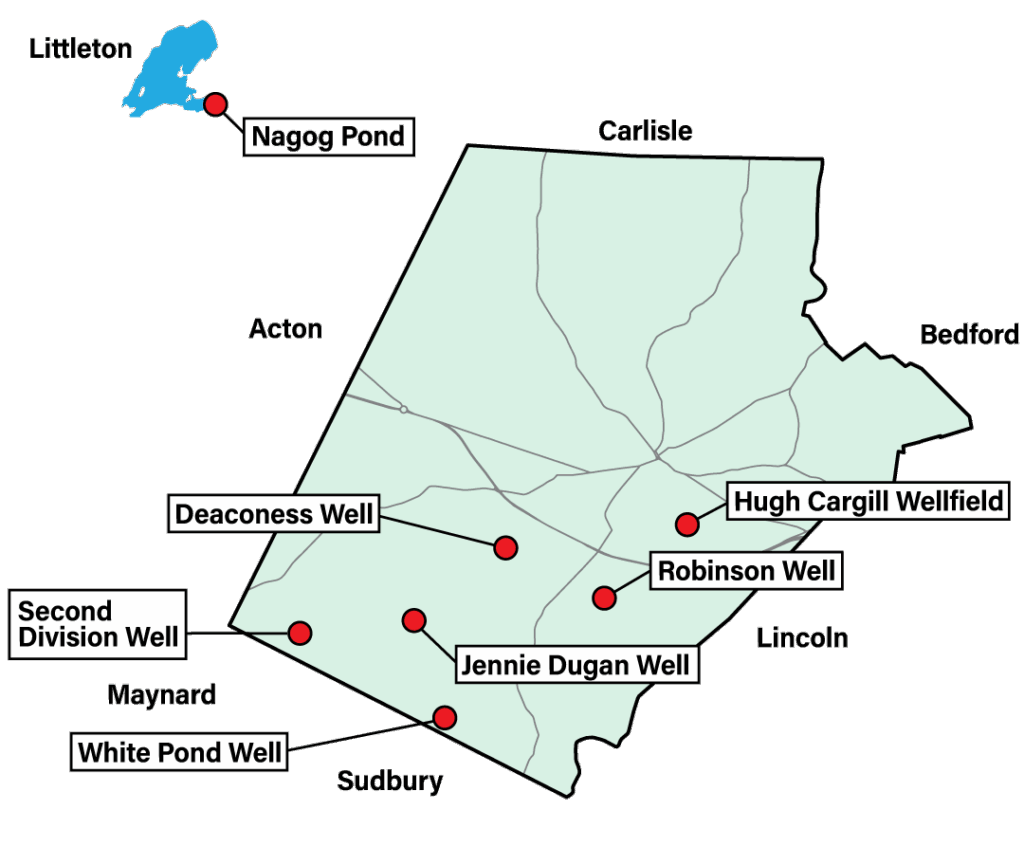
PFAS in Acton water sources
PFOA
- Second Division Well — 5.9 parts per trillion
- Hugh Cargill Wellfield — 4.3 ppt
- Nagog Pond — 3.7 ppt
- Jennie Dugan Well — 2.9 ppt
- Deaconess/White Pond Water Treatment Plant — 2.8 ppt
- Robinson Well — *
PFOS
- Hugh Cargill Wellfield — 2.7 ppt
- Nagog Pond — 2.1 ppt
- Jennie Dugan Well — *
- Second Division Well — *
- Robinson Well — *
- Deaconess/White Pond Water Treatment Plant — *
Source: Town of Acton sampling results
*Not detected.
The town also tests for other PFAS compounds; those either have no federal limit or a limit significantly higher than the 4 ppt maximum for PFOA and PFOS.
Regulation frustration
Staffers want to meet new thresholds. As residents worry, though, LaFalam said he doesn’t fret about PFAS: “We’re already on the right side of this,” he said earlier this year.
Director of Public Works Alan Cathcart said he’s frustrated about required warnings around bromate in Nagog Pond.
High bromate levels can raise a person’s cancer risk. While Nagog often exceeds federal limits, Cathcart said regulations don’t consider the fact that the town uses the pond only during the summer. Even when Nagog’s bromate measured around 11 parts per billion, officials said the 12-month average for Acton’s drinking water — which primarily comes from wells — was two parts per billion, or well below the limit of 10 parts per billion.
People still worried about bromate or PFAS can remove or reduce the compounds with home water filters. Officials urge residents who use filters to replace theirs on time.
Once installed, planned town PFAS filters will also catch bromate.
Regional water?
LaFalam said an effort to expand the regional Massachusetts Water Resources Authority could spare treatment upgrades and still deliver cleaner water.
The project could take 20 years, though, and it could cost more than $1 billion, so “we have to plan as if it’s never going to happen,” he told the PWC.
The expansion would link Acton and nine other communities to the MWRA. PWC member Sven Weber joked that he would personally dig the pipe from its current terminus along the Massachusetts Turnpike if that would accelerate the timetable.
“We’ll get him a shovel,” LaFalam told a Bridge reporter.


