Author explores Thoreau’s ‘profound sense of the holy’
Henry David Thoreau was an “iconoclast,” but he was “religious to the bone,” according to author Richard Higgins.
Can you be considered deeply religious if you disdain the church?
In Henry David Thoreau’s case, the answer is “yes.”
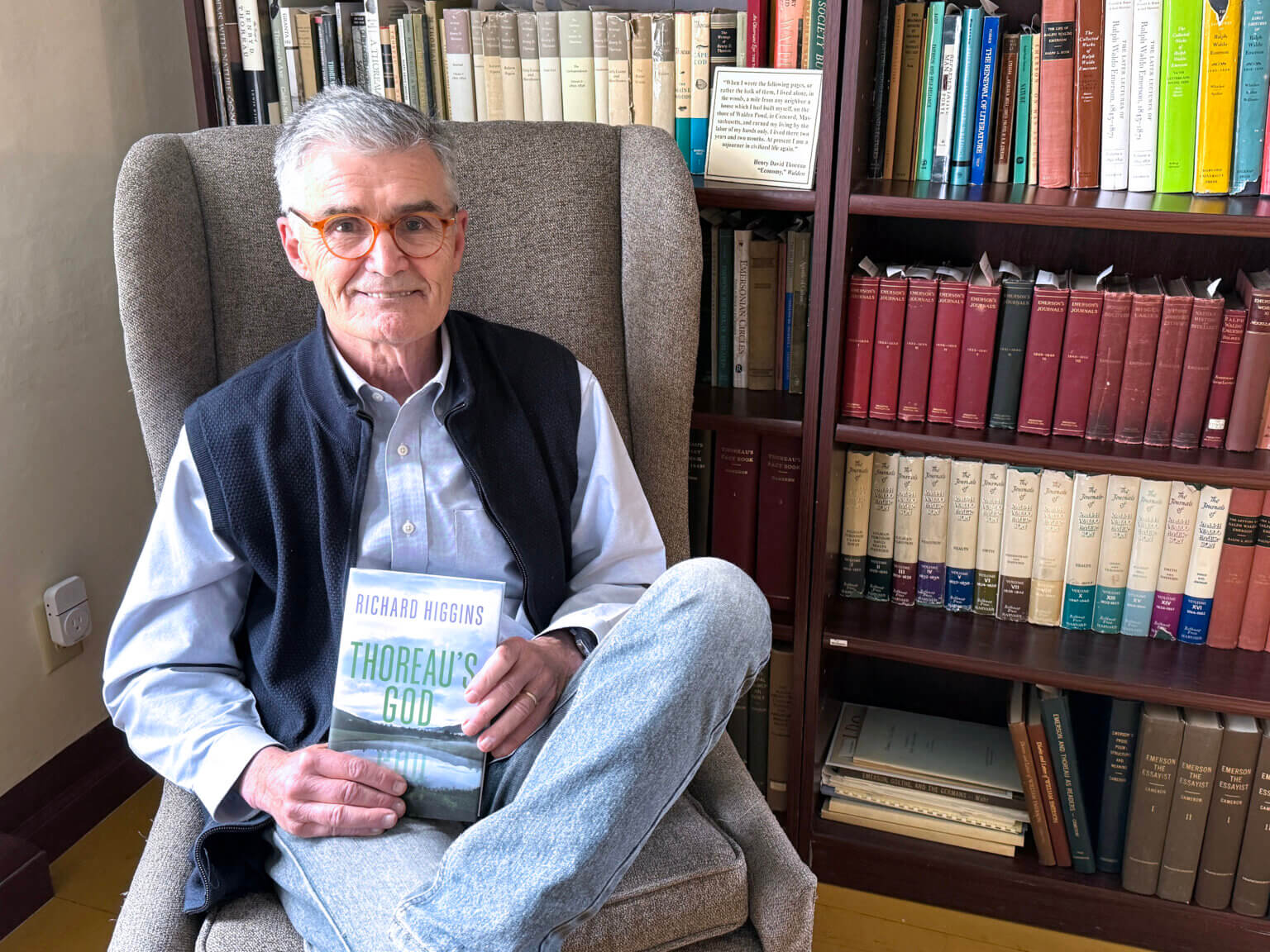
Richard Higgins explores this question in his latest book, “Thoreau’s God” (University of Chicago Press).
Higgins, an author, editor, book coach, and former staff writer for The Boston Globe, presents Thoreau as having a “fundamental reverence for the sacredness of life” despite believing that participation in a particular church was unnecessary.
The conventional view of Thoreau is that he was irreligious because he disdained organized religion, Higgins says. But while studying Thoreau’s journals, Higgins was “struck by how much Thoreau mentions God.” He was an “iconoclast,” but he was “religious to the bone,” Higgins says.
Thoreau, he adds, “didn’t avoid the meeting house because it represented religion, but because it failed to represent it. He felt it was disconnected from nature and initially cowardly about abolition.”
Although Thoreau, who grew up in the Calvinist tradition, went on to harshly criticize “respectable Christianity,” Higgins says, “he had a profound sense of the holy.”
Higgins agrees with Ralph Waldo Emerson, Thoreau’s contemporary, who once said that despite Thoreau’s “petulance” towards churches, he was “a person of rare, tender, and absolute religion.”
Thoreau as ‘mystic’
Higgins’ goal in writing “Thoreau’s God” was to “give a fuller picture of Thoreau’s spirituality,” he says. “I also thought his eclectic, experiential, and non-institutional spirituality might inspire spiritual seekers today.”
A careful reading of Thoreau’s “voluminous writings” was the foundation of Higgins’ years-long research process. He also consulted “everything on the subject” and talked to scholars and specialists in the field. That Higgins has a degree in religion from Harvard Divinity School “helped,” he says.
“Thoreau’s God” offers a series of 17 reflective essays that trace Thoreau’s spiritual development over his life, including “his belief in our innate spiritual abilities, his experience of God in nature, and his sense of the sacred in the ordinary.” Higgins says that the book, despite its scholarly subject, “is my original interpretation. I tried to write it so anyone can enjoy it.”
He presents Thoreau “as a mystic who, while firmly attached to the earth, was on a quest to commune with a divine mystery in nature — one that was immanent, or present, in nature and yet transcendent.”
Higgins says his subject’s “consistent view was that Walden Pond and the pickerel in it — as well as the trees, wildflowers, rainbows, and other natural objects — are images or emanations of God, and are not divine in and of themselves.”
For Thoreau, Higgins adds, “nature points beyond itself.”

The ‘individual’s individual’
Higgins, who also enjoys photographing the New England landscape, especially in Acton, says that he has been drawn to Thoreau for decades — his “Thoreau and the Language of Trees” was published in 2017. But he still learned much about the Acton naturalist and philosopher while researching “Thoreau’s God.”
Though Thoreau was “a complicated guy, whose self-righteous, judgmental, and dour side is better known,” Higgins says, “he was also intensely loyal to his family and friends and had an irrepressible sense of humor.”
His ideals, however, “were sometimes unrealistically high,” Higgins adds, “such as his very lofty view of friendship.” He was hurt, for example, by Emerson’s apparent inability to achieve what Thoreau hoped would be ‘a communion of souls’ with him.
Thoreau shunned the wealthy and the self-important, Higgins says, and he enjoyed talking to farmers and average people. He loved children and was close to Emerson’s offspring. When Thoreau died, Acton canceled school, and hundreds of children bearing flowers followed his cortege to his grave in Sleepy Hollow Cemetery.
“I think that speaks volumes about his real personality,” says Higgins.
When asked why there’s such a continued keen interest in Thoreau, Higgins says that “in a society ruled by algorithms and Big Data, [he] remains popular because he stands as the individual’s individual, an icon of honesty and integrity.
And, he adds, “because amidst our alienation from nature, he calls us back to a relationship with it as the source of mental, physical, and spiritual health.”
Thoreau asks us to “get at the root of what’s most important in our lives,” Higgins says. “It’s a challenge, but it’s a decision we can make.”