‘Being Henry’: A transcendent career depicting a Acton icon
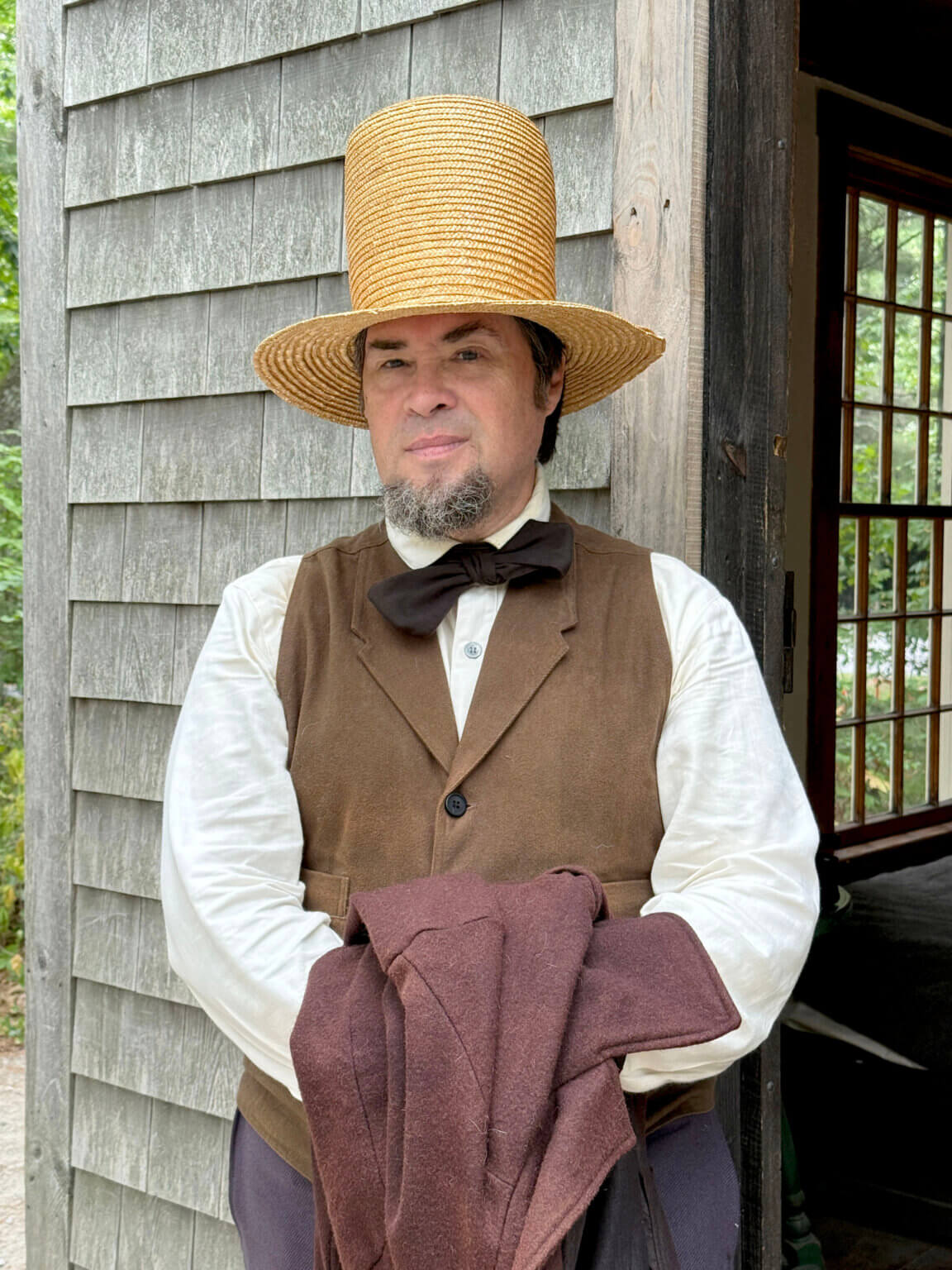
Richard Smith is hanging up his straw hat and sack coat after a final appearance at Walden Pond on September 6.
How does a punk rocker become a Transcendentalist?
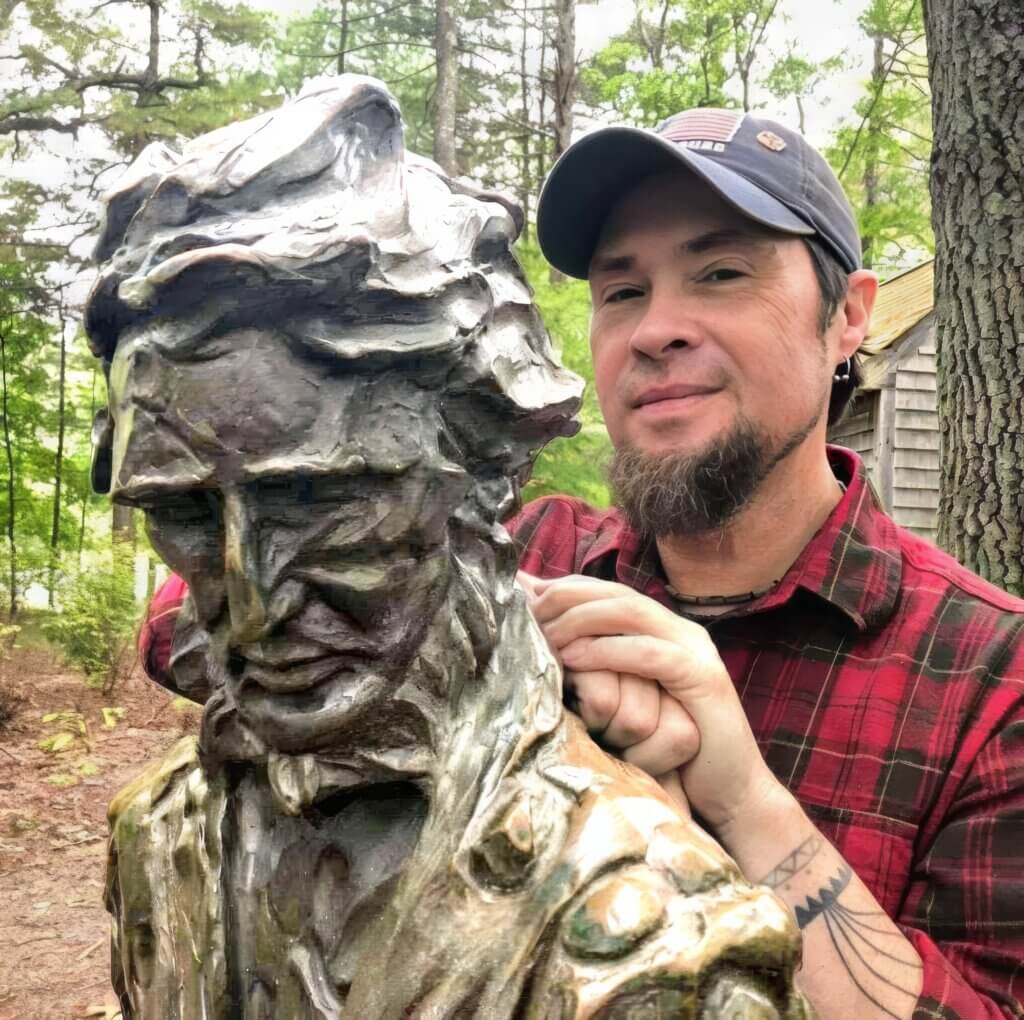
He removes his earrings and lowers his sleeves to conceal his tattoos of historic figures, native American designs, and literary quotations.
Richard Smith has spent the last 26 years “being Henry,” he says.
In character as Henry David Thoreau, he has interacted with visitors and answered questions about the 19th-century writer, philosopher, naturalist, and activist at Walden Pond State Reservation and has talked to school and church groups throughout New England and beyond.
Smith is hanging up his straw hat and sack coat after a final appearance at Walden on September 6. Though he will bid farewell to his alter ego, he will continue to work as a historian, writing and lecturing about antebellum U.S. history and 19th-century literature.
Jacqui Kluft, an interpreter at the park, calls Smith “a devoted living historian and quite frankly an asset to our understanding of the past.”
She adds, “Richard and his dedication to Thoreau have helped to perpetuate and give a legacy to the man who never thought he would have much of an impact.”
Leap to the past
In his 20s, after earning bachelor’s and master’s degrees in history at the University of Akron, Smith tried teaching, which he didn’t enjoy, and held several jobs, from custodian to telemarketer. Having been “drawn to the noise and rebellion aspect” of punk rock, he was the lead singer in several bands.
Thoreau would likely have approved of the punk movement, Smith says, given his advocacy for civil disobedience in the face of unjust laws.
Smith never lost the love for American history that began when he became “obsessed” with the Civil War in fifth grade. Later, he focused his reading on the causes of the war and the anti-slavery movement and pored over the works of Thoreau; Ralph Waldo Emerson; Bronson Alcott and his daughter, Louisa May; and Frederick Douglass.
In the early 1990s, the Cleveland-born Smith saw an ad seeking interpreters for Hale Farm & Village, a living history museum near Akron. For the next five years, he assumed the role of a schoolmaster and brickmaker in 1848. He didn’t know he would go on to “live” in the 1840s for many years to come.
While in Ohio, Smith began thinking that “it would be fun to be Henry.” He’d appear at local coffee shops in character and period clothing and sit on a stool, reading from Thoreau’s work and answering questions. His efforts drew only a handful of people, but they would set him on a new career path.
Dear Waldo
A visit to Acton in 1998 proved to be life-changing. “It was the most amazing place I had ever seen,” Smith says, adding that he left written notes on the Sleepy Hollow Cemetery graves of his heroes — Emerson, the Alcotts, and Nathaniel Hawthorne.
A move to Acton the next year was inevitable. Smith took a job as a ranger at Minute Man National Historical Park for two seasons and as an interpreter at Orchard House. He spent several years at the Acton Museum as a tour guide.
He soon realized that Acton was the ideal place to “be Henry.” As Thoreau, Smith ambled around the Old North Bridge, conversing with visitors, until one day he was invited to be an interpreter at the replica of the writer’s cabin at Walden.
Smith considers “The Journal 1837 – 1861,” which contains some 2 million words that Thoreau recorded as he took his daily walks, his most valuable resource in preparing to portray him. Visitors ask him questions that range from thoughtful to amusing and are sometimes meant to trip him up — to no avail, he says.
Corinne Smith (no relation), manager of the Thoreau Society Shop, says: “Richard has read enough and studied enough of Thoreau’s writing that he can whip off accurate answers to questions. He’s able to put visitors into the same time period as Thoreau and give them a sense of what life was like then.”
The questions Smith-as-Henry often gets involve a common misconception about Thoreau — that he lived in isolation at the pond. Not so, he tells them, saying that the pond with its nearby railroad was “not a howling wilderness,” and that he would visit family and friends in town. Thoreau writes in “Walden,” Smith adds, that “I am naturally no hermit.”
‘A guy from Ohio’
While in character, wearing a sack coat and straw hat at Walden and a gray frock coat when he lectures, Smith makes sure he doesn’t slouch, he says, and employs a formal, 19th-century speech pattern, avoiding the use of contractions.
“I don’t try to do an accent,” he says with a smile. “I’m not an actor. I’m just a guy from Ohio.”
Smith says Brent Ranalli, a living history performer who has portrayed Thoreau in eastern Massachusetts for the last seven years, will take over the role at Walden.
Retiring from his years as Henry will be bittersweet, but Smith says it’s time to move on and focus on his own writing. He’ll also continue working at the Thoreau Society Book Shop and serving as administrator for its Facebook page.
“I feel so blessed that Acton adopted me as Henry,” he says. “It’s been a gift, and I’m very grateful.”
Smith will be at Walden Pond on Saturday, September 6, from noon to 2 p.m.
September 7: This story has been updated to correct the name of Brent Ranalli.


