Electric school buses to bolster Acton’s power grid
The bus, acting as a pseudo-battery, can give back to the town’s energy grid if needed to save on peak-hour usage.
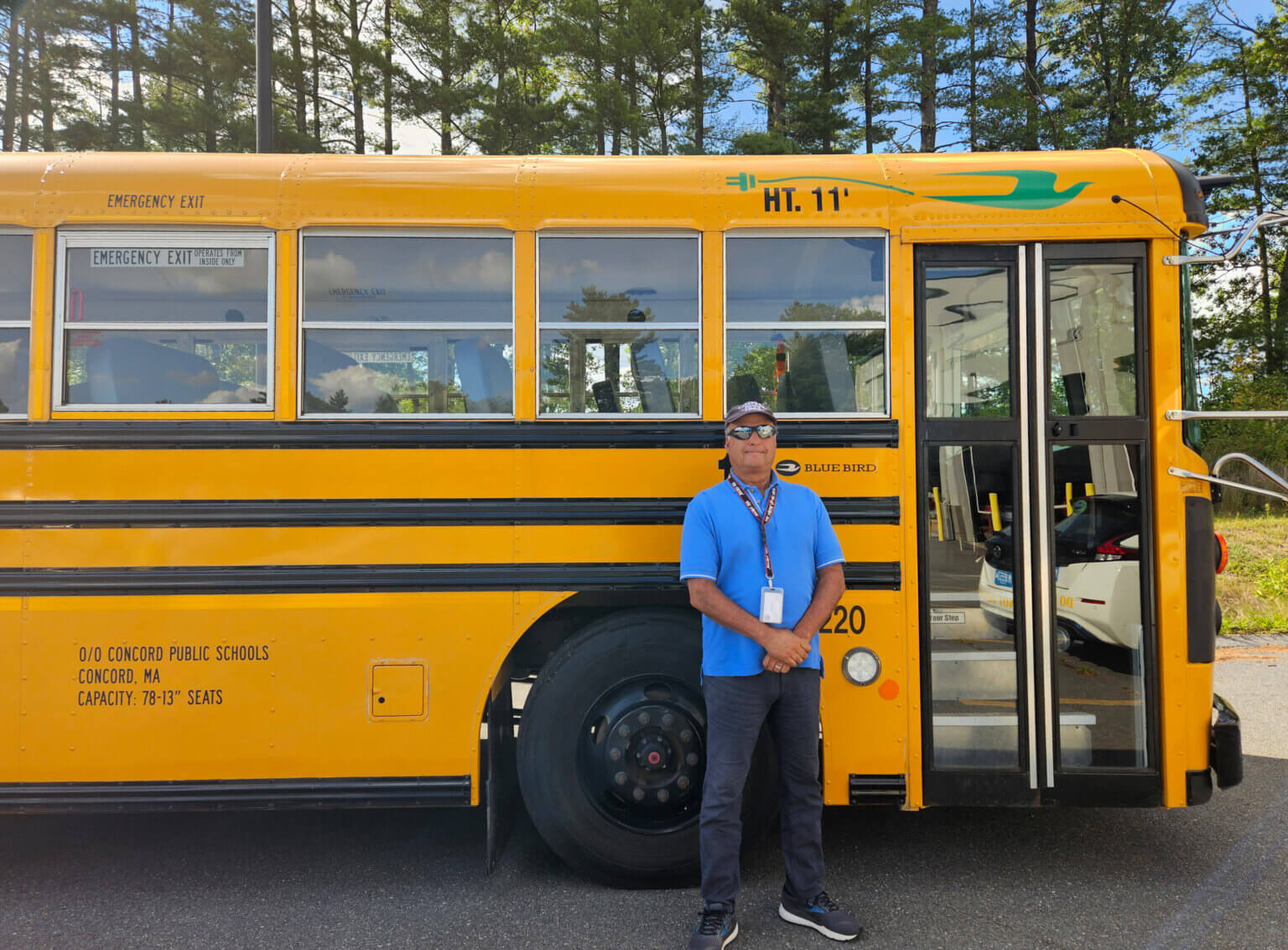
Acton school buses will soon do more than carry students. With help from a new grant, they can also help power the town’s electric grid.
The Massachusetts Clean Energy Center has partnered with Acton Public Schools and the Acton Municipal Light Plant to install a bidirectional charger for the schools’ fleet of electric buses — a single unit that can charge two buses simultaneously. MassCEC will fund the project entirely.

Assistant Superintendent of Finance and Operations Robert Conry, speaking on behalf of Superintendent Laurie Hunter, told The Acton Bridge in an email that the school district is “committed to exploring and pursuing sustainability for all the obvious reasons.”
School officials, in a news release, cited the amount of greenhouse gases produced by traditional diesel school buses as one motive for using electric school buses. CMLP board member Brian Foulds said in the release that a diesel school bus emits more than double its own weight in greenhouse gases every year, whereas electric school buses have near-zero emissions.
According to school officials, the new charger, funded by MassCEC, is more efficient and charges faster than current chargers. More important, they say, it is bidirectional, meaning energy can flow in and out of what’s connected to it. The bus can thus give back to the town’s energy grid when needed.
Conry told The Bridge the idea is that instead of buying electricity during peak hours of use, CMLP can use one of the school’s electric buses as a pseudo-battery, getting energy from it first before having to buy energy from outside sources. That would save CMLP money.
CMLP Director Jason Bulger told The Bridge in an interview that avoiding peak-hour purchases would further Acton’s clean energy goals.
“It’s some of the dirtiest energy we use,” he said, referring to the diesel often used to generate the extra energy purchased by the town. He expects that the bi-directional charger will be most useful for the light plant in the summer, when school is out and air conditioning consumes more energy.
Conry said electric buses are often 2.5 times more expensive than diesel buses.
So far, the district has bought three electric school buses: a 2017 wheelchair-accessible Lion bus for $336,145, a 2021 Lion for $334,283, and a 2022 Blue Bird bus for $364,422.
Conry said the district’s transportation department “has experienced challenges with the reliability” of the first two buses it bought. The manufacturer, Quebec-based Lion, is in bankruptcy proceedings. The most recent bus purchased, he said, has proven much more reliable.
Conry said the challenge for the district “is identifying ways to [be sustainable] that are cost-effective and can be achieved within the fiscal resources available.”
Bulger said it’s common to share savings with battery suppliers and that he fully supports the idea.
“Typically, you have these arrangements where a battery developer will come and say, ‘Hey, we’d like to put a utility-scale battery here, and we’ll pay for the battery, but you’ll be saving money, so we’ll split the difference saved,’” he said. Bulger said he thinks the schools would be amenable to that type of deal if it enhanced sustainability.
Previously, CMLP joined forces with the schools to install solar panels on the Ellen Garrison Building at Acton Middle School. Bulger hopes to continue partnering with the schools.
“At large, we have different stakeholders,” he said, but “we are both responding to the community goals for more clean energy and safety for the students.”


