Filmmakers walk Acton’s history for new Revolutionary War miniseries
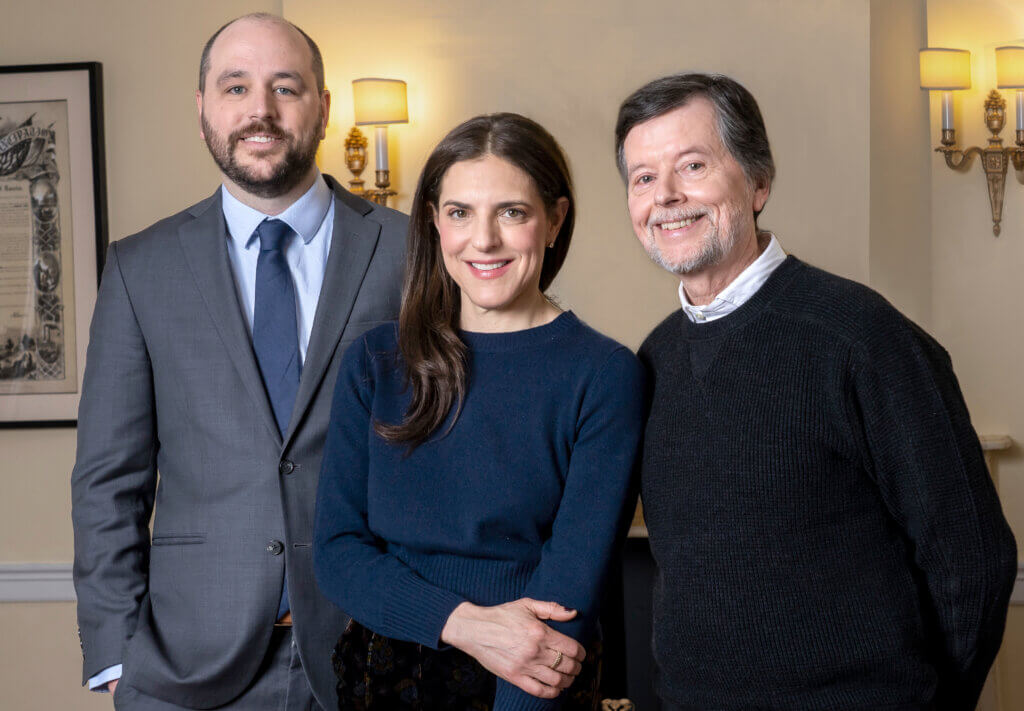
Ken Burns and his team from Florentine Films, Sarah Botstein and David Schmidt, are wrapping up work on “The American Revolution.”
When Ken Burns was 19 in 1972, he spent a summer in Acton, teaching at Acton Academy and tutoring an inmate at MCI. He often returned, visiting the area and his friend Doris Kearns Goodwin.
“I’ve known the Battle Road and all of the things for years and years and years,” he said. “So coming back was like coming home.”
Now, more than five decades later, Burns and his team from Florentine Films, Sarah Botstein and David Schmidt, are wrapping up work on “The American Revolution,” a 12-hour, six-part miniseries written by Geoffrey C. Ward, scheduled to air on PBS in November.
“As a student of history, and I still am a student of history, even before I began this project, Lexington and Acton have particular significance on April 19,” Burns said. “It’s a big, big, important date.”
Traversing the past
Many here have learned about the Revolutionary War, perhaps even taking a middle-school field trip to the North Bridge and buying a tricorn hat.
“I think a lot of people tend to bury it in nostalgia and in kind of a gallant, bloodless myth,” Burns said. “It’s a much more interesting and much more complicated story.”
And for authenticity, Schmidt said, there’s nothing like being in the place where history happened.
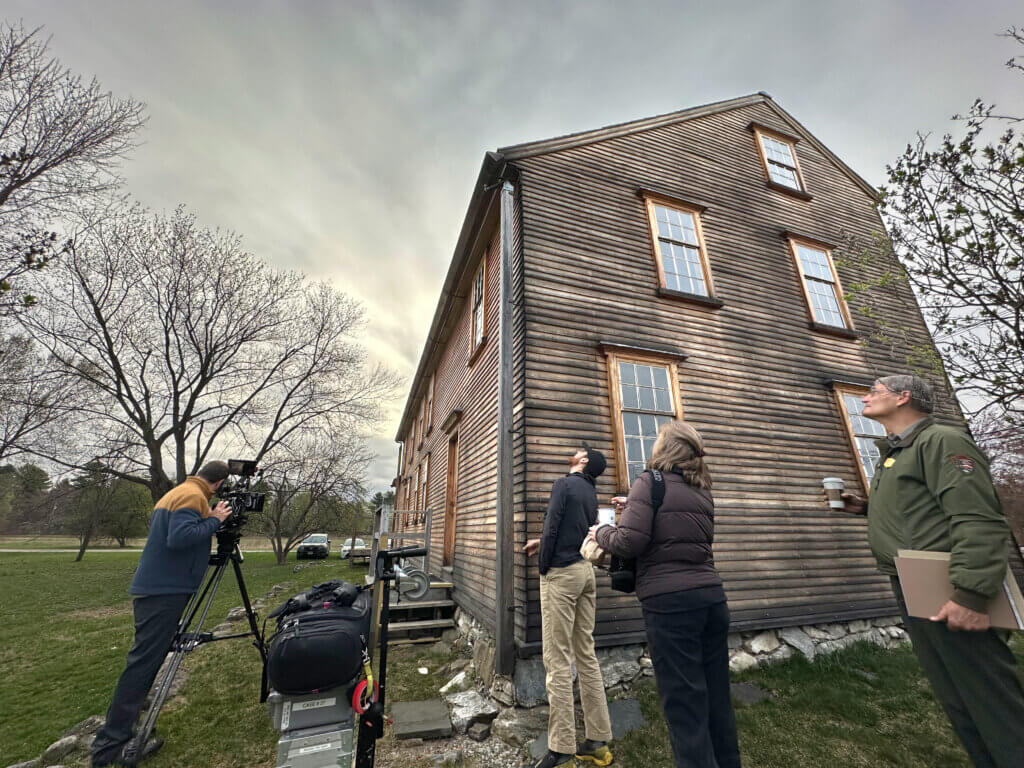
“You have to walk the ground,” Schmidt said. “So even before we were filming, I went to the Battle Road, and walked it, and went to the North Bridge and all the places around the Barrett House. … This is the moment when the Revolutionary War began, and we wanted to be at that place where that happened if we could.”
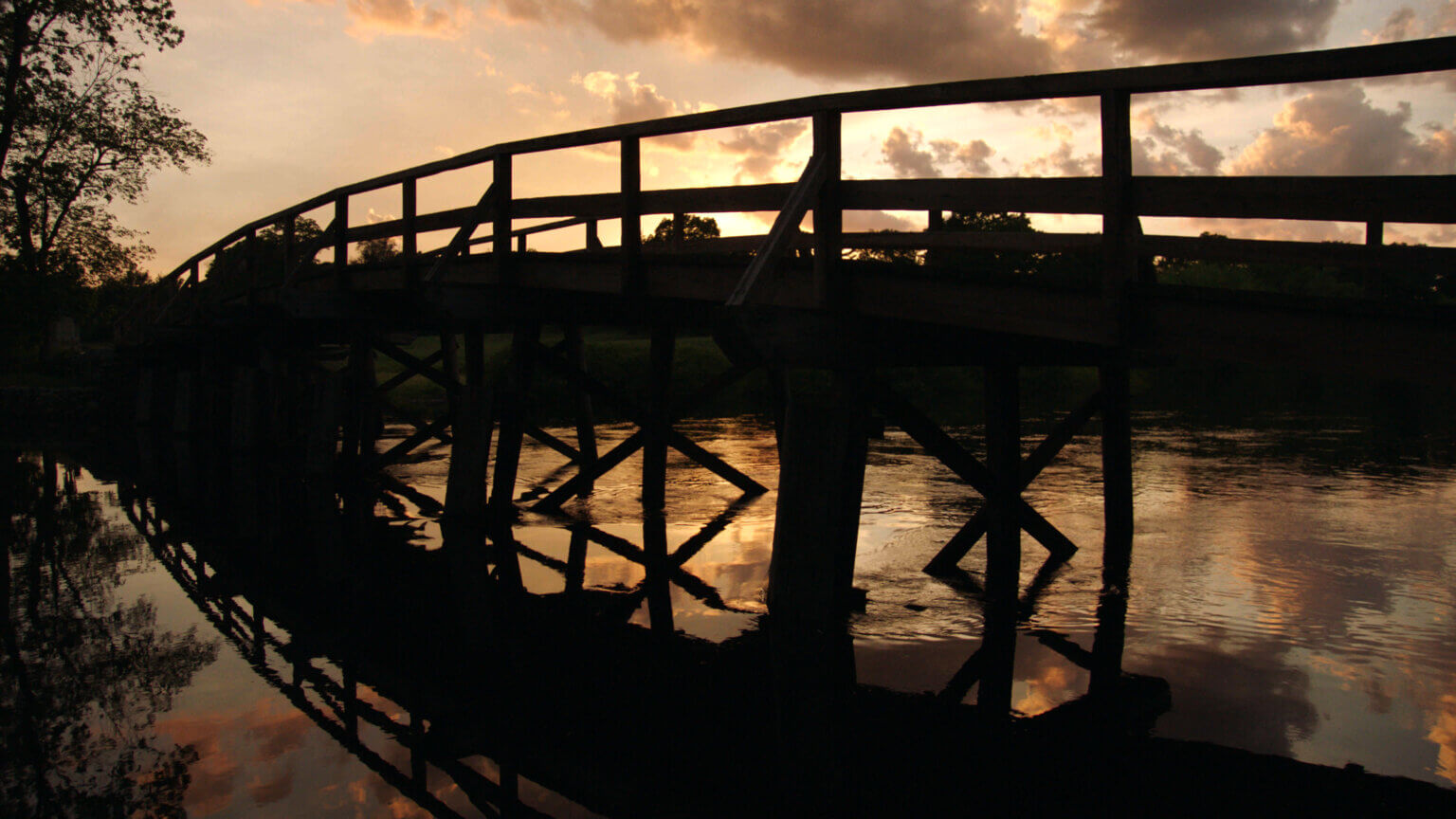
Crews filmed at Minute Man, North Bridge, the Old Manse, the Barrett House, and along Battle Road.
Schmidt noted that camera crews must often avoid power lines and other modern tells when shooting a period piece. While Minute Man’s open space offered the historical feel of the 18th century, there were still adjustments to be made for legitimacy.
“There’s a road that runs behind it, and statuary … we had to aim our cameras in such a way that you wouldn’t pick up on that, or wait till the traffic passed,” he said. “We wanted to be sure we weren’t filming the public.”
Filming in spring also meant the trees were still bare, so the road was more in view — but that was intentional.
“It would have helped cover things if we did it out of season,” Schmidt said. “But we wanted to look like April 19,” he said.
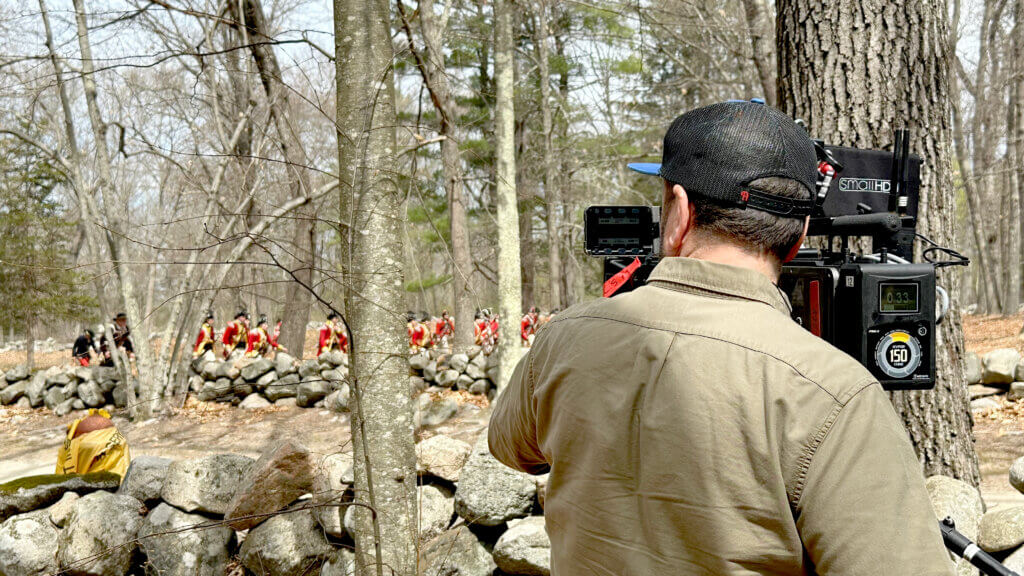
The series shows what it was like to lead an 18th-century army into battle — with the resources available at the time. Schmidt said local reenactors were key to that, faithful to the period in uniforms, equipment, and musketry.
“[They] were so committed to getting it right,” he said. “It definitely helped for us making the film to see this in action. I think it will help for those watching the film to just be able to see human activity and animal activity and imagine what kind of an undertaking this really was.”
Authentic voices
Burns called the miniseries “intimate and personal” and said the filmmakers drew on “hundreds of first-person voices.”
“I think in the case of New England in particular, the literacy rate was so high that we really are able to hear from a wider variety of the people … who lived in 18th-century North America than you might find in other situations,” Schmidt said.
One of those voices is Hannah Davis, whose husband, Issac, was the first colonial officer to die in the Revolution. Acton’s Scott Vanderhoof is their direct descendent.
“It’s amazing to think about what she was thinking seeing him out the door and what she was thinking seeing him come home at night with the bodies of two other men from town,” Schmidt said. “How quickly it became a war just that morning. We know now that things were heading that way, but they couldn’t have known on April 18 that they would be at war tomorrow.”
The documentary includes the “big names” — like John and Abigail Adams, George Washington, and Phyllis Wheatley, for example — but also other figures the filmmakers discovered along the way.
“We are always trying to show a full picture of what happened and who was there, the names that you’ve heard of, and the names that you haven’t,” Botstein said.
Those stories include women, persons of color, and Indigenous patriots, Burns said, such as the Haudenosaunee — or the Iroquois Confederacy — the Stockbridge Indians, and enslaved Black men.
“We just want to tell a good story. So we’re like umpires calling balls and strikes,” Burns said. “Including everybody’s story makes everybody’s story better.”
‘The most significant’
Burns first considered this project in 2015; it was serendipity, he said, that the premiere will coincide with the 250th anniversary.
“You don’t plan for these things, and all of a sudden you realize … oh, my goodness, we’re going to come out in 2025 and that’s 250 years,” he said. “Nobody was talking about it” in the beginning.”
Burns said that telling the story of a war is always complicated, but it would be hard to overstate Acton’s role in the American Revolution.
“The first episode is all the setup, and it climaxes with Lexington and Acton, and that day, April 19, where the world was changed forever,” Burns said.
“The American Revolution, and the subsequent formation of the United States, is the most important event in the last 2,000 years. If you’re counting on what, after the birth of Christ, was the most significant event, I don’t think you could argue that it was not the American Revolution.”