Mute witnesses to the Revolution, houses display flags for 250th
If only these walls could talk.
If only these walls could talk.
What would they say about having watched and heard the British Regulars marching by in their startling scarlet coats during the early hours of April 19, 1775?

These are the Witness Houses. Some are more familiar than others, such as Wright Tavern, Orchard House, and the Colonial Inn.
Most are private homes that reflect the devotion and commitment of the owners who serve as their stewards. The stories of these places are colorful and sometimes complicated. In one lived a midnight rider, and another was a saddlery and leather shop that was looted by the retreating British.
As a project of Concord250, many of the Witness Houses, which the Regulars passed as they moved through Acton, are displaying flags designating them as such. So are many of the town’s 1775 Houses (though some are older than that), which are situated away from the British route but stood during the war.
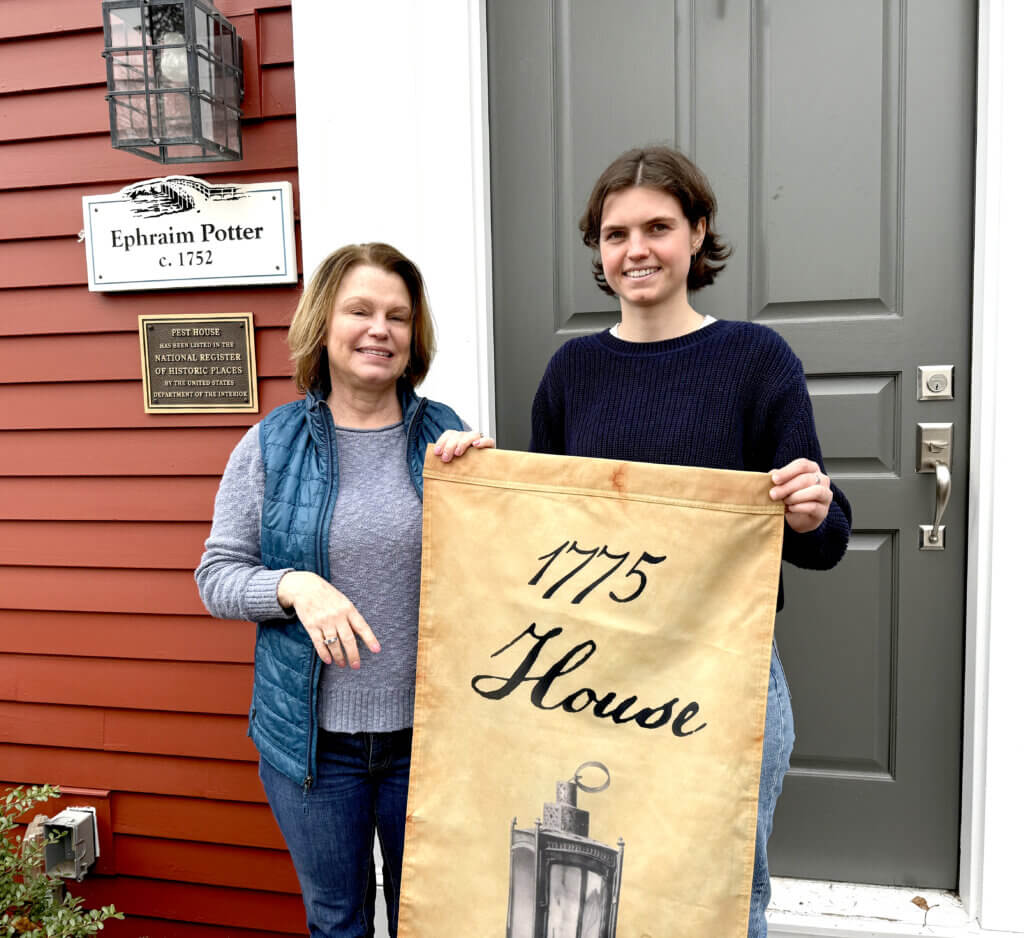
Witness House flags depict The Minute Man statue, and 1775 House flags bear an image of one of two lanterns that were hung as a signal in the belfry of the Old North Church in Boston on the night of April 18, 1775.
Faye Allen, a member of a subcommittee of Concord250 whose purview is community participation, designed the flags with the input of Acton printer John MacKinnon and Holly Cratsley, chair of the subcommittee.
Anne Clifford, Acton’s senior planner, last year provided a list of 24 Witness Houses and 51 1775 Houses, using the Battle Ground Scenic Byway Corridor Management Plan of 2021 with input from Minute Man National Historical Park, though the National Park Service houses are not included.
A former saddlery
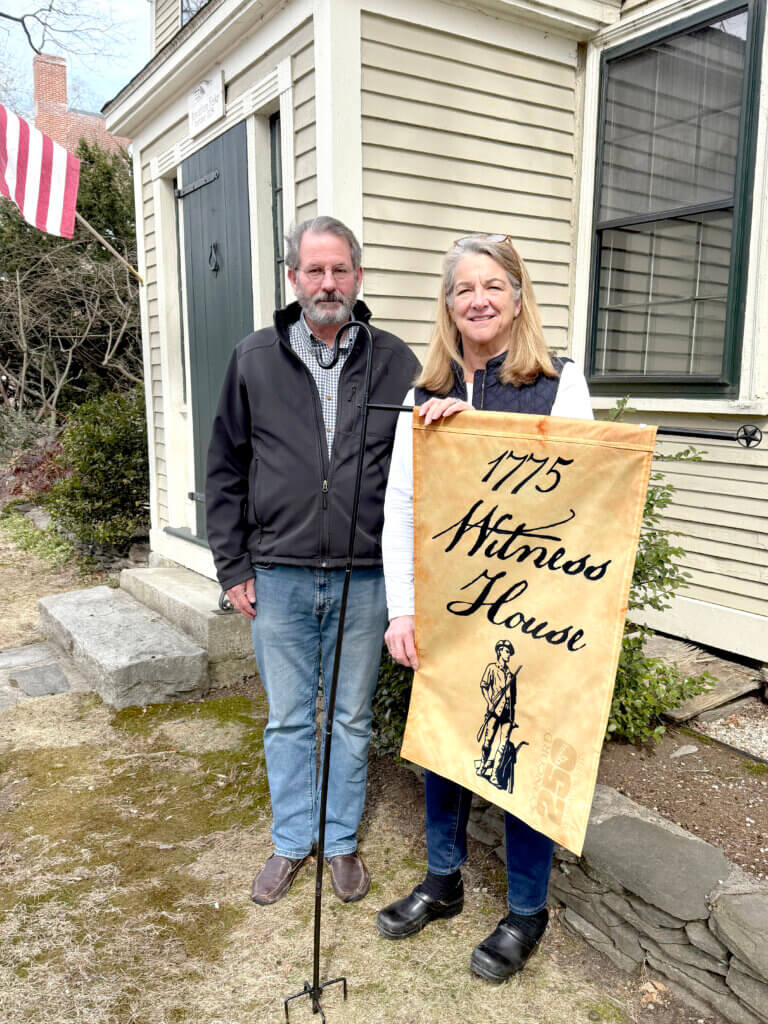
Jeff and Maryann Street have lived in the Jonathan Fiske House for 35 years, raising their two sons there. The handsome home, with its wide board floors, low ceilings, and five fireplaces, is shaded by a pair of gracious maples. It backs up against a ridge on which Acton’s Liberty Pole, a symbol of the town’s defiance of British authority, stood before the British destroyed it.
Also known as Reuben Brown Saddler’s Shop, it’s one of several Witness Houses situated along a stretch of Lexington Road referred to as Acton’s American Mile.
The house plaque reads “before 1724” and it could be as old as 1687, says Street. According to town records, it was built on a lot that was part of the Peter Bulkeley estate, and Fiske was a saddler living there in 1725.
Reuben Brown ran a saddlery in the building later on and lived next door, in a house that dates to 1720, according to town records. Having witnessed the advance of the British just outside the center of Lexington, Brown had raced back to Acton on horseback to report what he saw to Maj. John Buttrick.
Though his saddlery had struggled, Brown’s shop prospered when Massachusetts began preparing for war. He supplied the militia with leather items, including holsters, belts, and cartridge boxes.
Emerson’s cigar
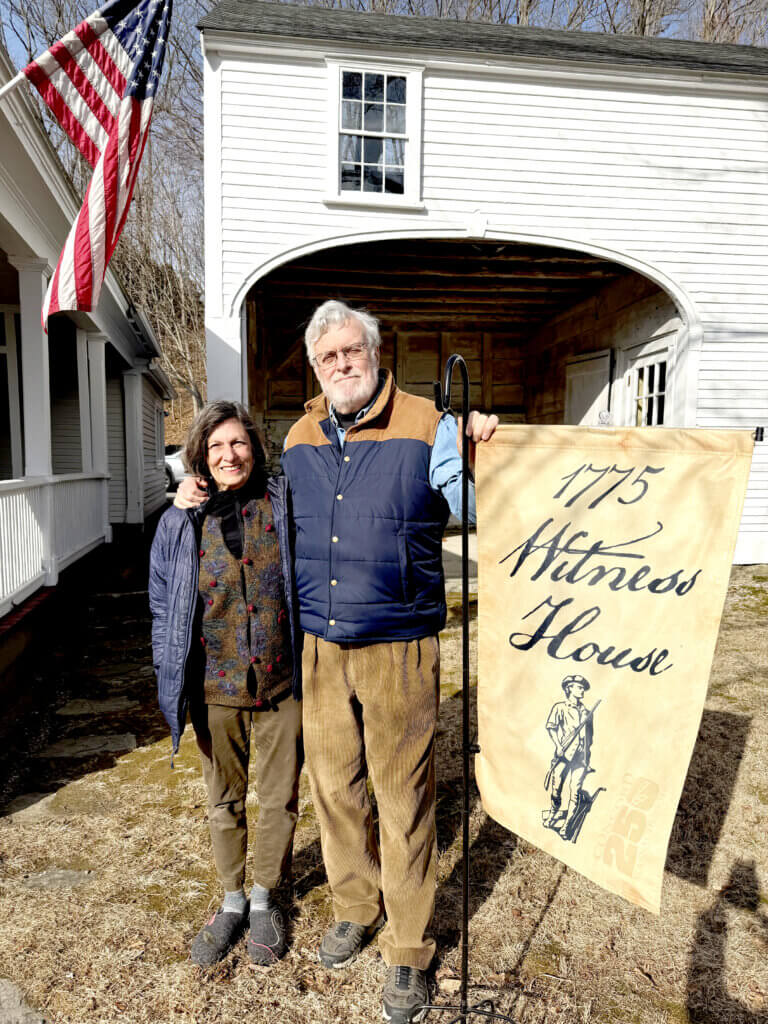
Marilyn Brady says she gets “goosebumps” when she sits in the dining room of her and her husband John’s 1719 home known as the Brown/Beaton/Heywood House on Lexington Road. “I think about who sat in this room before us,” she says.
The Bradys moved into the home 32 years ago, drawn to the town’s school system and the house’s proximity to the center. They did considerable restoration work, including stripping 10 layers of paint from the wainscoting. The home has rare lapped, beaded siding and a lack of corner boards, which help date it to the early 18th century. An adjacent barn was built in the early 1800s.
The home’s many owners have included its namesakes John Brown, a blacksmith; John Beaton, a local merchant and town treasurer; Jonathan Fay, an attorney who married Lucy Prescott; and Dr. Abiel Heywood, town clerk for 38 years. The Bradys’ son and daughter-in-law — after some lobbying by Marilyn — named their baby Lucy Prescott Brady.
Marilyn shares a story about the house that involves Ralph Waldo Emerson, who lived nearby from 1835 to 1882. Emerson enjoyed a good cigar, but his wife, Lidian, did not want him to smoke it while he was walking into town. When he left his house, Emerson would tuck the cigar into the fence that used to line the front of what is now the Brady home.
A midnight rider
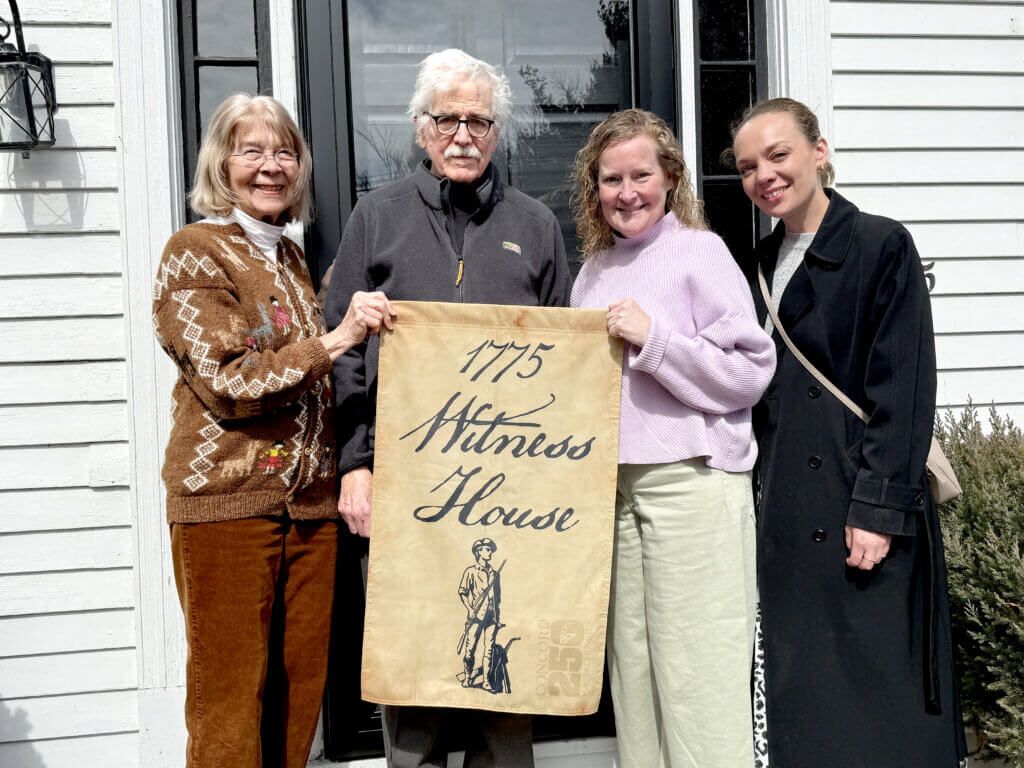
Frank “Rich” Feeley and Susan Ellsworth live in the A and J Moore House further east on Lexington Road. It contains four connected units. The oldest part of the structure dates to 1740, and Ellsworth’s unit, which she purchased 33 years ago, dates to 1839.
The house is an example of how complex the history of a 17th-century structure can be. It sits on a lot granted to “the first settler,” Francis Fletcher, records say, and was sold to Abel Prescott in the 1770s. Prescott’s son, Dr. Samuel Prescott, was one of the famed “midnight riders.” A plaque on the stone wall in front tells his story.
Samuel learned of the British approach while in Lexington, courting a young woman, and he rode to alert Acton. Stopped by the British, who are said to have threatened to “blow his brains out,” Prescott spurred his horse, cleared a stone wall, and escaped while the officers were arresting Paul Revere.
The house and farmland were sold to Capt. Abel Moore, a sheriff, in 1830, and by that time it was a double house that Moore shared with his son, Capt. John B. Moore, and daughter-in-law. John Moore kept cows and farmed the land, experimenting with growing strawberries and asparagus.
‘How it used to be’
Maria Fitzgerald’s home, the Ephraim Potter House, lies about a mile from the town center, close to Route 2, and has an unusual claim to fame. It is considered to be the oldest “pest house” in the country, used to quarantine people afflicted with diseases such as smallpox or cholera.
The home dates to 1752 and was added to the National Register of Historic Places in 1977. It displays a 1775 House flag.
Before the Revolution, Potter is said to have stored supplies, such as tents and canteens, for the militia. His wife, Sarah, died of smallpox in 1792 and is buried in a graveyard across the road.
Fitzgerald and her husband, John, had lived in antique homes before moving to the Potter house 30 years ago. John, who passed away last year, was passionate about history, and he and his family participated in reenactments. He was a member of His Majesty’s Tenth Regiment of Foot in America, a historically re-created infantry unit founded to portray the service of the British Army during the Revolutionary War.
One of their two children, Erin, is a geologist who, as a third grader, conducted an archeological dig in the yard with her father. They unearthed marbles, an iron hook, pottery pieces, and a gold thimble engraved with the letters CEP that may have belonged to Corinna Prescott, who married the house’s second owner, Elbridge Hayden, in 1842.
John’s dream was to protect and preserve the home, Maria says, and that is what she continues to do. The house has four fireplaces, and Maria loves to have a fire going and “think about how it used to be” when the home’s early occupants kept warm that way.
The subcommittee has handed out 44 flags and hopes that more owners of designated houses will participate. Contact Allen at [email protected] to pick up a flag.


