On ‘The Avenue of Grievance,’ signs of Estabrook dispute linger
Homeowner Brooks Read said his signs aren’t coming down, and Town Manager Kerry Lafleur said officials have no recourse.
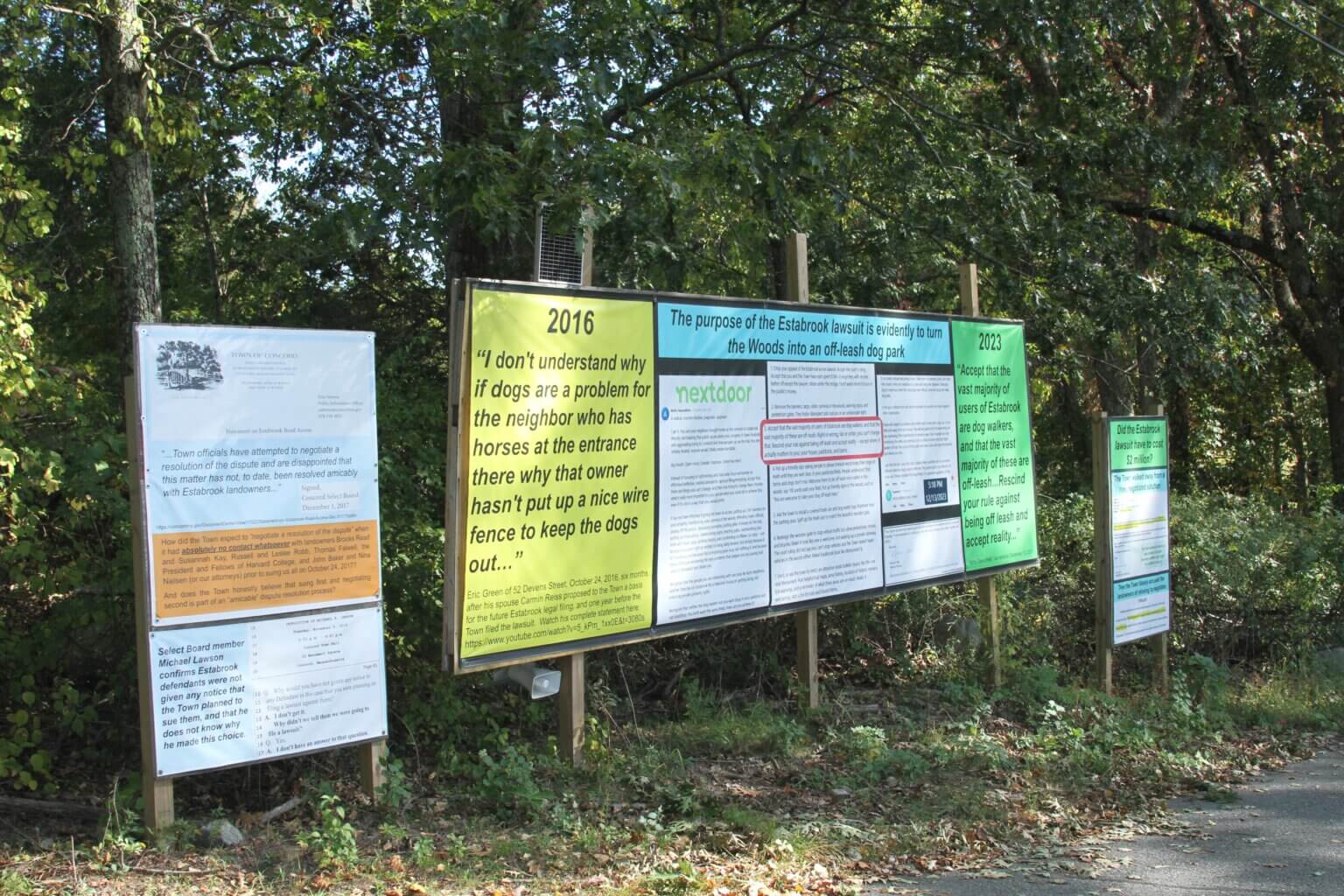
The legal brawl may be over. But prominent signs along Estabrook Road could linger as thorny reminders of the town’s access fight.
Officials sued homeowner Brooks Read and several co-defendants in 2017 to affirm public access along the unpaved Estabrook Trail. As lawyers locked horns, Read memorialized his side of the case with large — and oft-criticized — wooden displays.
Massachusetts’ top judges sided with the town earlier this year, effectively ending the defendants’ state appeals.
Despite this, Read said his signs aren’t coming down, and Town Manager Kerry Lafleur said officials have no recourse.
The vinyl banners include screenshots of emails and court documents. Speakers play looping audio clips from public meetings, and Read monitors cameras mounted on the signs and along the trail.
Read wouldn’t say how much he’s spent on the sizable creations, but he said it’s “much less than 1%” of what he’s forked over for attorneys — roughly $500,000.
Trails Committee meeting minutes from 2024 show the panel supported probing whether the billboards complied with the town’s sign ordinance.
Lafleur told The Bridge that she hadn’t been up to Estabrook Road recently, but last she saw, Read’s signs were on private property.
“It’s not any different than anybody having a ‘No Kings’ [sign] or whatever,” she said.

‘What would Thoreau say?’
Defendants have warned that the state Supreme Judicial Court ruling could cause confusion about other Massachusetts roads that were “discontinued” through the same county mechanism as Estabrook.
Read said he won’t be making the appeal, but he asserted the state should pass legislation to codify that abandoned roads “were in fact fully discontinued, did not exist, and therefore could be built over.”
State Rep. Carmine Gentile (D-Sudbury), whose district includes parts of Acton, disagreed about that need, saying the Estabrook case actually clarified state law.
Co-defendants Leslee and Russ Robb acknowledged that the town “successfully sued for legal access.” They’re worried this could allow developers to one day destroy the idyllic woods.
With the lengthy litigation, Leslee Robb said they have also stopped earlier talks about finding an organization to oversee long-term public use of their land and have gated many of their trails.
“The town won the battle but lost the war,” she said.
The signs, meanwhile, keep drawing criticism.
Resident Michael Dettelbach dubbed the trail past the banners “The Avenue of Grievance.”
He said the audio component “sort of freaked my dog out at first.” Now, he said, his 16-month-old rescue isn’t fazed.
Dettelbach hopes to see the signs come down. He’s not alone, and even if the town can’t require their removal, current Trails Committee Chair Bob White said he thinks the signs should come down.
“What would Thoreau say, after all?” he said.


