Rare form: Library acquires early photograph of Emerson
The image is believed to be the second or third earliest known photograph of America’s most famous Transcendentalist.
When collector Victor Gulotta was looking through a group of old photographs he had recently purchased, he felt a surge of excitement on viewing one of the images.
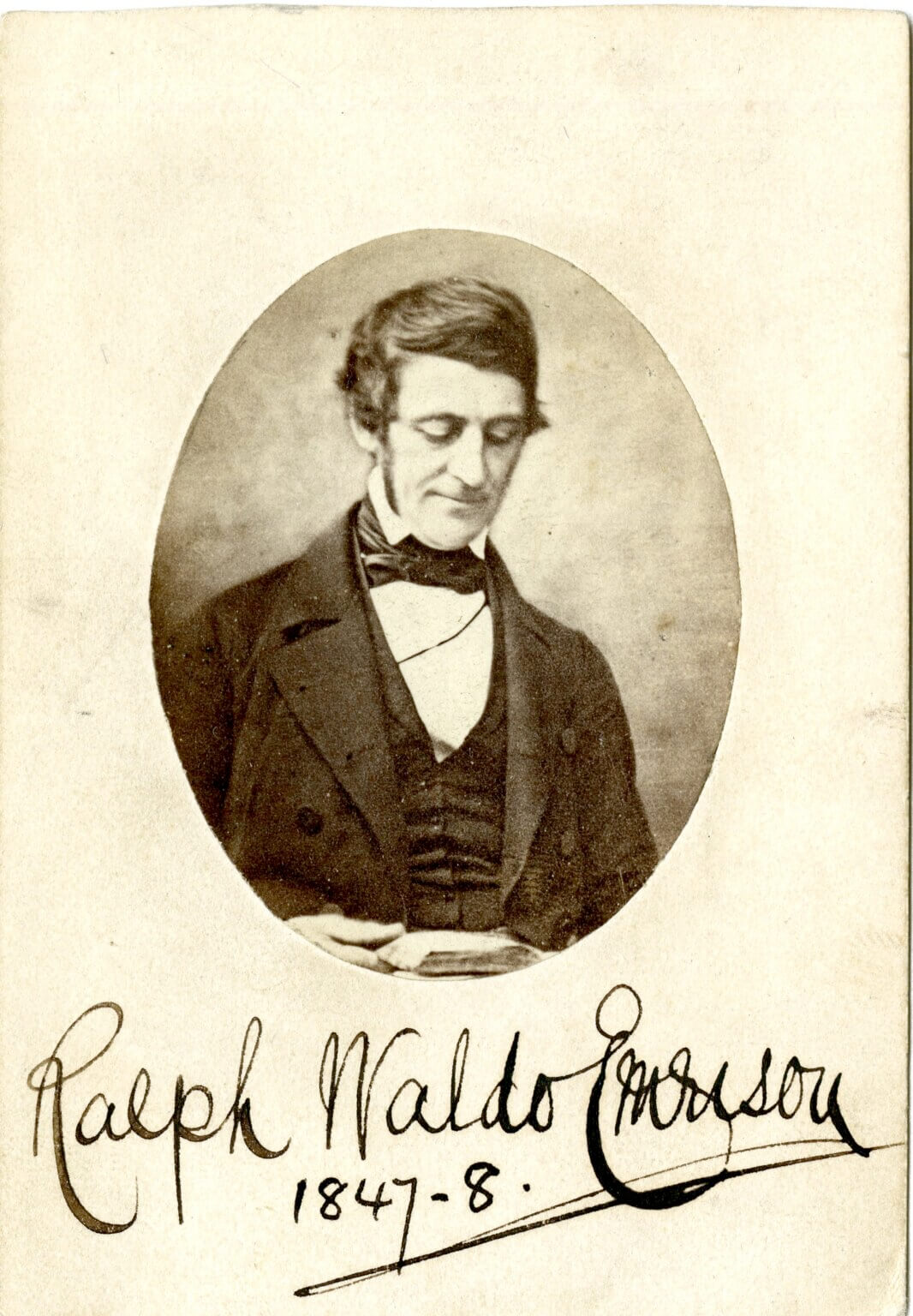
It was a circa-1860s carte-de-visite (CDV) photograph of Ralph Waldo Emerson, taken from an original daguerreotype, circa 1848.
A collector of CDVs of literary figures, Gulotta says, “I recognize known images of Emerson,” and “this one was not familiar to me.” Emerson, born in 1803, would have been in his 40s when the photograph was made.
The image is believed to be the second or third earliest known photograph of America’s most famous Transcendentalist, Gulotta later learned.
“It’s always delightful to stumble upon an object of great rarity — one that has somehow escaped notice by expert collectors and dealers,” says Gulotta, who lives in Sudbury. He once purchased a first edition of a book by A. Bronson Alcott, only to get home and notice that it had been inscribed in Alcott’s hand to a friend.
Cause for celebration
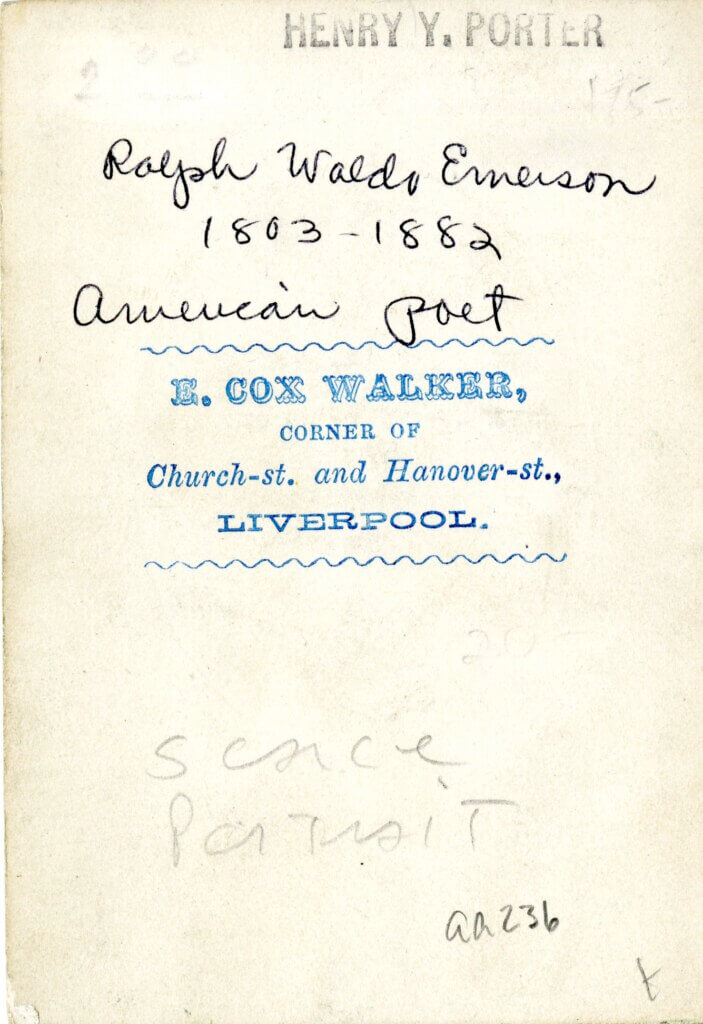
The Emerson image was among hundreds of photographs that had been buried in a collection for more than half a century, says Gulotta. The daguerreotype was originally produced in Liverpool when Emerson was visiting England, and the card was made there years later.
Gulotta reached out to the Acton Free Public Library, much to the delight of William Munroe Special Collections Curator Anke Voss.
“Thanks to my predecessor Leslie Perrin Wilson, and the late Joel Myerson’s comprehensive Emerson iconography,” which was co-compiled with Wilson and published in 2016, “it was possible to confirm it as among only very few known images of Emerson from the 1840s,” she says.
“It’s an exceptional addition to our collection and to the iconography of Emerson that will be recognized and celebrated by Emerson scholars around the world,” says Voss. “The figures in the Transcendentalist movement are always in the forefront of how Acton tells its story.”
The Acton Free Public Library Corporation, funded by private philanthropy, maintains the buildings, grounds, special collections, art, and other property of the library. “We are thrilled to be adding this significant image to Special Collections, and we are so appreciative of the generous donors who made it possible,” says Sherry Litwack, president of the corporation’s board of trustees.
A lovely, soft look
The image on the card is small, approximately 2½ inches by 2 inches in size. In it, Emerson wears a slight smile and appears relaxed and content. “The softness of his look — it’s lovely,” Voss says.
Having one’s portrait made in the mid-1800s was no easy task, Voss points out, requiring hours of standing or sitting still in a studio. Early on, it was a costly venture, too, and only people with resources had them done, she adds.
A carte-de-visite means “a calling card,” but there’s no way to determine conclusively if this is how the esteemed writer, orator, and philosopher used it, Gulotta says. CDVs, introduced around 1859, were collected “much in the way that baseball cards have been collected,” he adds.
Emerson is said to have been fascinated by photography, jotting observations in his journals and published writings, according to Myerson and Wilson’s iconography. He wrote in one entry, “I prefer the photograph to any other copy of the living head: the light is the best painter, & makes no mistakes. Truth evermore.”
‘Enjoy and explore’
Devotees of the “Sage of Acton,” as Emerson was nicknamed, can find in Special Collections extensive images of him. He is represented in paintings and pieces that include a 60-inch-high seated figure in the Library’s rotunda, commissioned after Emerson died in 1882 and unveiled in 1914, and a carved marble bust, circa 1884, from an earlier clay model. Both are by Daniel Chester French, an Emerson family friend and creator of the Minute Man statue that stands at the Old North Bridge.
Anyone can see the newly acquired image, Voss says, along with everything else in Special Collections. “We don’t like to refer to what we have as ‘treasures,’ as that makes you think of them as being locked up. And that’s not how we want to be viewed. We are a place where people can enjoy and explore Acton’s history.”
Special Collections is open Mondays, 10 a.m. to 6 p.m., and Tuesdays through Fridays, 9 a.m. to 5 p.m., at the Acton Free Public Library, 129 Main Street. For more information, visit concordlibrary.org/special-collections.