Recalling the removal and resilience of Nipmucs, museum honors Indigenous history
A fiber basket is the heart of a new, ongoing exhibit titled “Chemacheg Menuhki: Paddle Strong.”
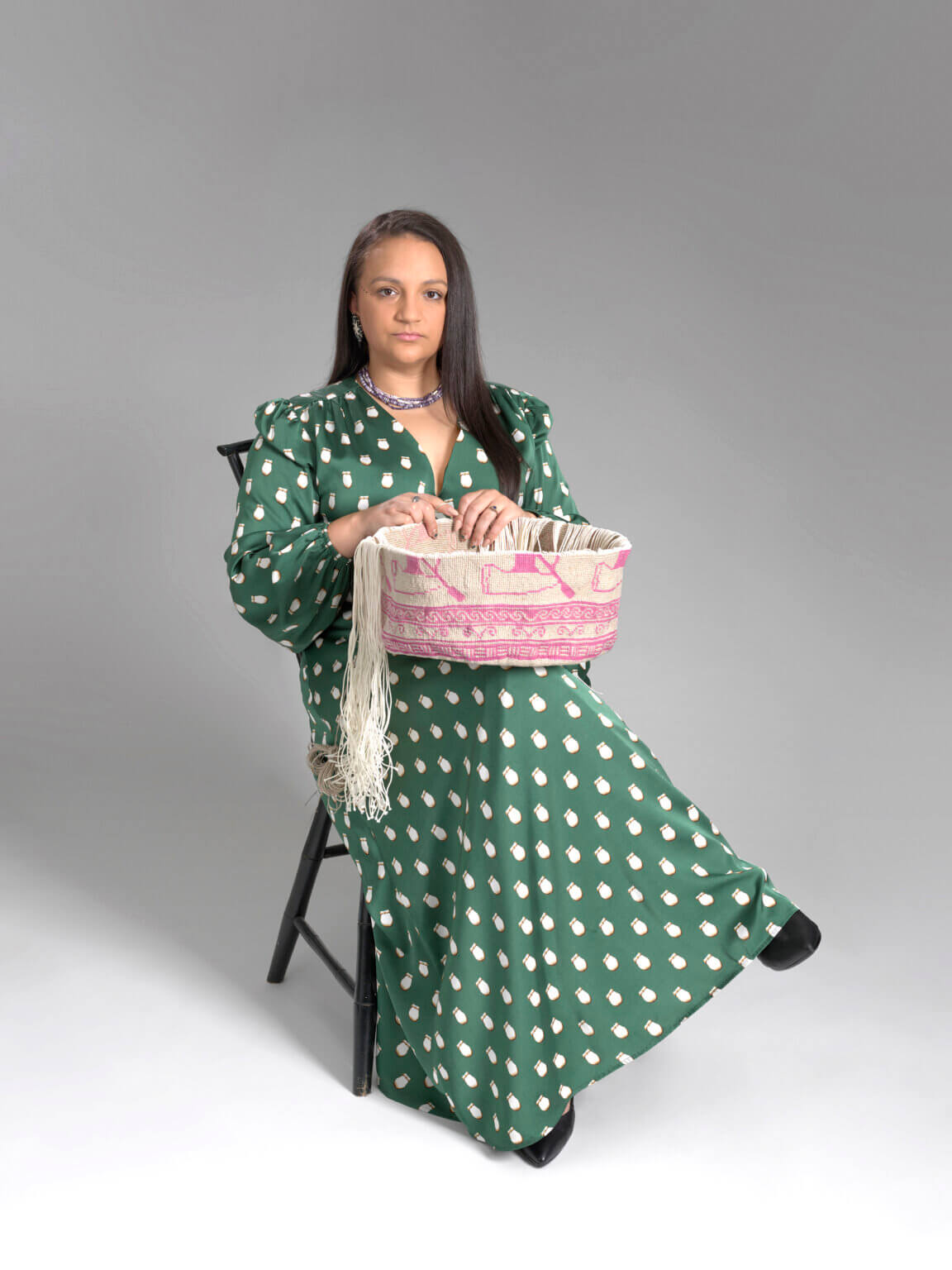
“It serves as a touchstone to countless stories of the past, present, and future.”
Brittney Peauwe Wunnepog Walley, a member of the central Massachusetts-based Nipmuc tribe, is talking about the fiber basket she created. Its iconography explores a tragedy that befell Native Americans living in the area.
The basket “draws on traditional Indigenous weaving techniques and highlights rarely acknowledged facets of regional history,” according to the Acton Museum. It is the heart of a new, ongoing exhibit there titled “Chemacheg Menuhki: Paddle Strong.”
“As a contemporary creation, this basket insists on the recognition of Indigenous people living today,” says Walley, the exhibit’s co-creator. “It is up to us to weave together the countless stories of past, present, and future.”
A related media installation will include a film about Walley’s creative process by award-winning filmmaker and educator Roberto Mighty. It will “further enhance how visitors learn more about contemporary Indigenous textile arts and the traditions passed down through generations of weavers,” according to the museum.
A troubling past
In a little-known chapter of local history, 58 Nipmuc people were sheltered on the Acton property of John Hoar in 1675. That is, until colonial forces seized and forcibly moved them to Deer Island in Boston Harbor.
The island’s bucolic name belies its troubling history. It once served as an internment site for Native Americans during King Philip’s War in the mid-1670s.
The war was a major clash between English colonists and Native Americans in southern New England — a last-ditch effort by the latter to resist the expansion of English settlements. It was named for the sachem of the Wampanoag, Metacom, who had adopted the English name Philip, and was one of the bloodiest conflicts for both Native Americans and settlers in U.S. history.
Though the 58 people didn’t fight for either side and wanted only to live peaceably in their village, the government worried they would turn against the English and join the rebellion. Hoar, a Acton lawyer who lived in what would later become Orchard House, home of Louisa May Alcott, sought to shelter a group of friendly Nipmucs, members of the Nashobah Praying Indians.
Fearful settlers opposed what Hoar was doing, and the Army got wind of his protection of them. The Nipmucs were forcibly moved to Deer Island with several hundred other displaced Native Americans who had been living in the region. Most of those confined were women and children.
At least half of those interned died due to starvation, freezing temperatures, and lack of shelter. Some survivors were smuggled off the island and sold as enslaved people in places such as the West Indies.
Raising awareness
In the 1800s, Deer Island served as a penal colony and then a quarantine hospital and a reformatory. Today, it is the site of a technically advanced wastewater treatment plant that began operating in 1996 and has a 2.6-mile-long perimeter walking trail. The island is part of the Boston Harbor Islands National Recreation Area.
Local Indigenous people today memorialize the displacement and resilience of their ancestors through customary ceremonies and by paddling the region’s waterways. Every year, descendants of the tribal nations involved in King Philip’s War host a commemoration of their ancestors’ ordeal on Deer Island.
They seek to raise awareness of the treatment that Indigenous people suffered and “to demonstrate their communities’ longstanding resilience and resistance,” according to the National Park Service.
Lisa Krassner, the museum’s executive director, says, “Our hope is that the exhibition will inspire visitors to reconsider the history of this region and recognize the continued contributions of Indigenous communities.”
The exhibit is funded by the Coby Foundation and funded in part by Mass Humanities.
The Acton Museum, 53 Cambridge Turnpike, is open Friday to Sunday, 10 a.m.-5 p.m., and Monday to Thursday, 10 a.m.-4 p.m.


