Time Outdoors: A wintertime wealth of winged wonders
Consider starting a family tradition of putting out feeders and give our feathered friends a helping hand.
To avoid spilling birdseed, I set the whole bag in the metal garbage can and slit the sides open with my pocketknife.
“That’s so satisfying,” my 9-year-old daughter said as the contents flowed out. The smell of the seed filled the shed, and it reminded me of my sister’s barn in Vermont. It is oddly comforting to unload ample winter supplies, especially on a cold, dark December afternoon.
We have two bird feeders, and she helped me hang and fill both. The one by the living room window also got blocks of suet. The other, a tray feeder, hangs on a metal hook pushed into the ground that was centered expertly by Aquinnah, who firmed up the ground on one side with a rock. I made a mental note to buy her some work gloves “like mine” for Christmas.
Early the next morning, it was clear a transformation had occurred. Like magic, life filled our little yard.
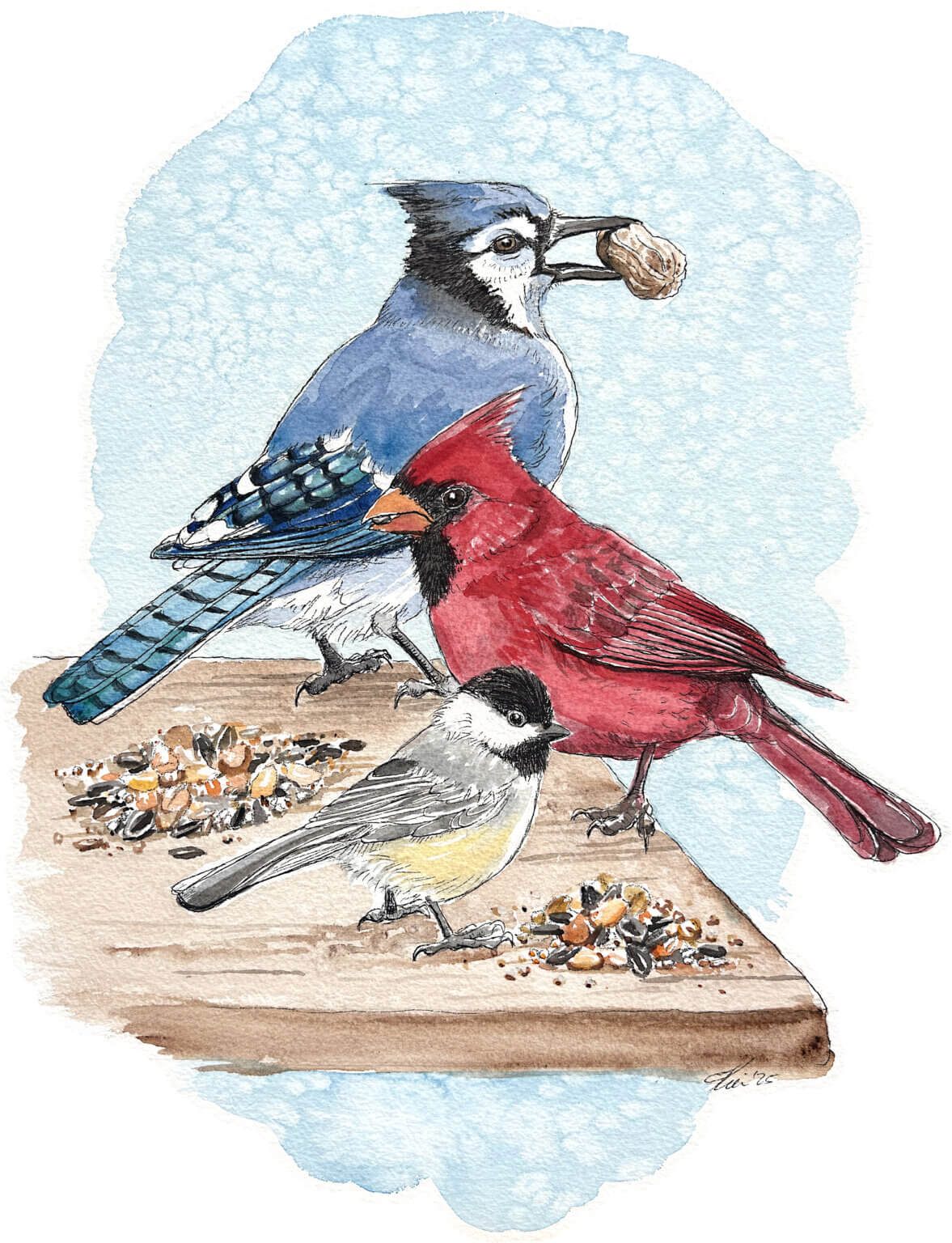
As we made breakfast, blue jays and cardinals took turns at the tray feeder. Small juncos hopped about on the ground. A little red squirrel we’d never seen before was named Ruby on the spot, and a fat gray squirrel watched all the commotion from a fence post. A tufted titmouse and a half-dozen house sparrows made trips for sunflower seeds. A flicker was spotted, flashing yellow flight feathers, and a downy woodpecker nipped bits of suet, inches from the window. I struggled to get Aquinnah to concentrate on her breakfast. Distracted, she kept looking back over her shoulder out the window. She made the bus, just barely.
A legacy of learning
I grew up in Belmont, our house bordering conservation land. Every winter, my dad hung feeders and taught me and my brother and sister about the winter birds, as distinct from one another as a lion from a zebra. Over time, we learned them all, thanks to him and a well-worn Sibley bird book. I assumed all dads and kids did this.
Then, in fifth grade, my class did a project on local birds. The kids and teacher were amazed that I knew them all. I, in turn, was equally amazed that they didn’t. I now realize that my father had given me a great gift. Of curiosity. Of awareness. Of observation. Of knowledge. Passing this gift on to my daughters today amplifies that gift. Thanks, Paw.
Generally speaking, feeding wildlife is frowned upon, but as food sources become scarce in winter months, supplemental feeding of backyard birds is widely accepted as ecologically beneficial.
Feeders should be kept clean and placed near trees or other cover to avoid providing easy opportunities for birds of prey. If bird seed becomes wet or moldy, discard it and clean out the feeder. Choose high-quality mixes appropriate for our area, and make sure there is a solid percentage of high-energy seeds, such as sunflowers. Consistency is important, especially when very cold temperatures roll in, so keep feeders full once you start. And be sure you can see them well from the house.
Once you get feeders set up, it should not take long, and there are about two dozen common bird species you can expect to visit.
Avian attributes
Black-capped chickadees are common visitors to feeders and are the state bird of Massachusetts. Hearty and energetic, they are known for their distinctive “chick-a-dee-dee” call. Blue jays are large, and their bright, blue plumage allows for easy identification. Common locally, they are excellent mimics and imitate red-tailed hawks to scatter other birds from the area as they gather food. They prefer flat “tray” feeders and will probably visit you this winter if you make them welcome.
Dark-eyed juncos migrate south from Canada and are ground feeders. They are not flashy (small, with dark gray over white) but are beautiful in their own way. Their seasonal arrival from the north says “cold weather is here.” And in a wintry landscape, bright red northern cardinals look borrowed from a holiday card. They do not migrate south and are so popular that seven states have chosen them as their state bird.
The Cornell Lab of Ornithology is an excellent resource for researching birds and has published a list of regional species you can expect to see at your feeder. Along with the ones mentioned above, look for mourning doves, nuthatches, robins, crows, song sparrows, grackles, starlings, and various kinds of wrens and finches, among others. Cedar waxwings are a real treat and might visit if you add bits of sliced fruit to your tray feeder. Keep a bird book handy, and you will soon recognize different species at a glance.
Also watch for less-common, exotic visitors, especially if there are storms that could blow them north.
Passing on knowledge about nature learned from your parents to your own children is precious. Seeing them light up at the natural world and want to learn on their own is even more so.
Until next month, happy holidays — and I hope you will consider starting a family tradition of putting out feeders and giving our feathered friends a helping hand as they spend Time Outdoors while over-wintering in Acton. If you do, you will probably transform your yard into a place of discovery and wonder.
My daughter will be getting off the school bus soon, and there should be just enough light for us to sit by the wood stove for an hour or so and observe our little sanctuary together. I can’t wait.
Wilson Kerr lives in Acton and is an avid outdoorsman and amateur naturalist. This monthly column is written to help grow awareness of the wonders of nature. In this increasingly fast-paced and technology-packed world, it is important to stop and take in the beauty of our area and the animals that inhabit it. The author hopes this column will be read by families and used as a teaching tool and that you will spend more … Time Outdoors.