Time Outdoors: Telltale signs in the winter woods
The snow had silently recorded all the comings and goings of life. What I would write about was so obvious I got goosebumps.
I am sometimes asked how I choose topics for this column. The honest answer is that I usually wait for a sign, an interaction with nature. A sighting or experience provides the subject, and the excitement I feel flows into my writing.
On a recent ski trip to Vermont, a friend asked me what I was writing about next. I told him I had only a few days to decide and asked for ideas. He paused and explained he wished he was more attuned to nature. He lamented he was “just seeing woods” rather than the interconnected parts I saw. I did not ask the origins of this but suspect it was due to a lack of exposure earlier in life versus a conscious choice.
So, back in Acton, still without a topic two days before my deadline, I took a walk in the winter woods near our home, a late afternoon break from emails and furnace-heated air. Crisp and cold, several feet of snow made the access trail deep and uneven — winter’s grip still strong and unyielding.
I entered the forest, and all was quiet. As I walked, I saw no wildlife, not even a squirrel. The impression the land conveyed, at first, was of a lifeless expanse of gray and white, shut down and waiting for spring. I walked on, checking my watch and thinking about work.
At that moment, the wide, deep tracks of a whitetail buck cut perpendicularly across the trail in the snow, in a straight line off into the forest — going somewhere important, on his own terms, ignoring the easier tamped-down path, even after such a long and trying winter. I started thinking about the conversation in Vermont and my column, and an idea sparked to life. I remembered winter walks with my dad when I was little and what he taught me about careful observation.
I pulled on my hood, slowed my pace, and took some deep breaths. And there it was. The snow had silently recorded all the comings and goings of life. What I would write about was so obvious I got goosebumps. Triggered by a single track in the snow, showing me, teaching me, reminding me.
The more I looked, the more I saw. A hole in the snowpack with acorn bits scattered at its lip, where a red squirrel had enjoyed a meal before retreating to its leafy tunnel beneath.
Prey and predator
As if on cue, I spotted the holy grail of winter signs. Among the big pines, 10 feet off the trail, were the unmistakable striations of wings landing and, in the muddled middle, faint stains and gunmetal gray bits of fur where a mouse or vole had ventured topside and met its end by way of a raptor’s sharp talons and beak. I was thrilled.
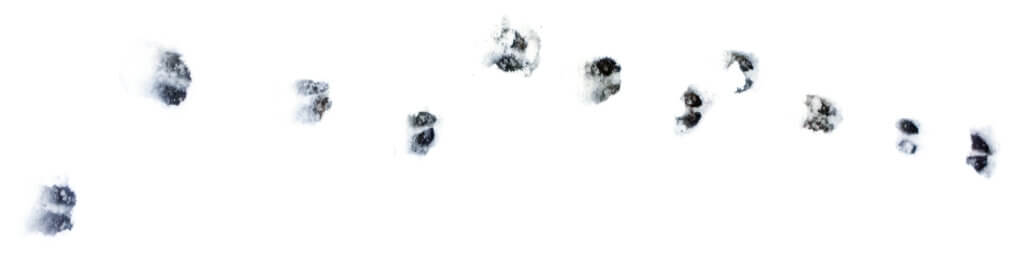
Rabbit tracks have a very distinctive 2×2 pattern, and I saw more and more as I got to the flat land near the swamp. Next to the boot track, the chalky gray scat of a fox or small coyote lay in the snow, a mouse tooth clearly visible in the fur-packed deposit.
I found signs of drama. Bounding doe tracks, grouped together, 6 or 7 feet apart, with flecks of now-frozen mud scattered about. I imagined them feeding by digging up acorns with their sharp hooves, warm in their hollow-fiber winter coats — and then being spooked by something and flying off through the moonlit night.
Fresh gray squirrel tracks crisscrossed between trees, looking like miniature raccoon prints. And then the linear, perfectly aligned tracks of a fox, hunting toward the west into the now-setting sun.
Splendid splinters
Even the surface of the snow itself held signs, as tiny bits of wood gave testament to the work of small black and white downy and hairy woodpeckers above, hammering holes after detecting beetle larvae and ants under the bark, among the branches.
Tuned in, I could not walk 10 feet without finding something new. Some tracks were crisp and fresh, while others were days old, edges dulled. Deciphering them, I could picture the interactions, the variety of animals, the adaptation, and survival. All this happening in this one patch of town woods. Remarkable.
Even the trees themselves were worth pondering. I looked up. Shut down and leafless, huge oaks and maples and birches stood dormant, waiting. I wondered at the potential of each — energy stored and ready to reactivate. Buds and seeds and sap. Ancient wisdom.
Hurrying and impatient at first, all I saw was a cold, quiet, seemingly lifeless forest. I could have easily returned home with no topic to write about. Yet once again nature delivered. The signs were everywhere but revealed themselves only after I slowed down and calmed my mind. I am thankful for being taught this lesson as a child — and for that buck for reminding me. I hope all who read this will explore and learn and inquire, so they, too, can see the wonder all around us.
It’s been a long winter, but the sap is running in the sugar maples and the male cardinals will soon be singing from the high branches. Then the red-winged blackbirds and robins and peepers and all the harbingers of spring. May you notice and appreciate these signs. May they bring you peace and inspire you, as you spend Time Outdoors.
Wilson Kerr lives in Acton and is an avid outdoorsman and amateur naturalist. This monthly column is written to help grow awareness of the wonders of nature. In this increasingly fast-paced and technology-packed world, it is important to stop and take in the beauty of our area and the animals that inhabit it. The author hopes this column will be read by families and used as a teaching tool and that you will spend more … Time Outdoors.