Time Outdoors: The deer dilemma
Though sometimes hard to see, the effects of deer overpopulation are increasingly detrimental.
Some changes to the natural world are easy to spot. A beaver dams a stream and floods a forest. A tree falls and blocks a hiking trail. A brush fire blackens a meadow.
But most people have a hard time noticing gradual, incremental changes. Here in Massachusetts, our deciduous, broadleaf forests are slowly but surely being degraded by situations of our own making. Although this change is difficult to see in real time, there is growing awareness and concern among those studying the issue.
For thousands of years, apex predators like wolves and mountain lions thrived here and kept populations of prey animals like white-tailed deer in check. In the old-growth forests, the diverse and interconnected parts of the ecosystem were largely in balance.
Europeans’ arrival disturbed this balance, as wolves and mountain lions were trapped, shot, and poisoned with a goal of total elimination. In Massachusetts, the last wolf was killed in 1840 and the last mountain lion in 1858. Hunting was mostly unregulated, and by the late 1800s even deer were functionally extinct. Trees were cut by the millions, and soon the state was 75% deforested. Things were way out of balance — bleak, even.
Thankfully, a combination of changing fuel sources, farmland abandonment, and tree planting allowed the land to rebound dramatically in the last century. Today, second-growth forest (along with the remaining old growth) once again covers 60% of the state. This, combined with hunting regulations and conservation efforts, has enabled many forest-dwelling wild animal species to proliferate.
Feeding and breeding
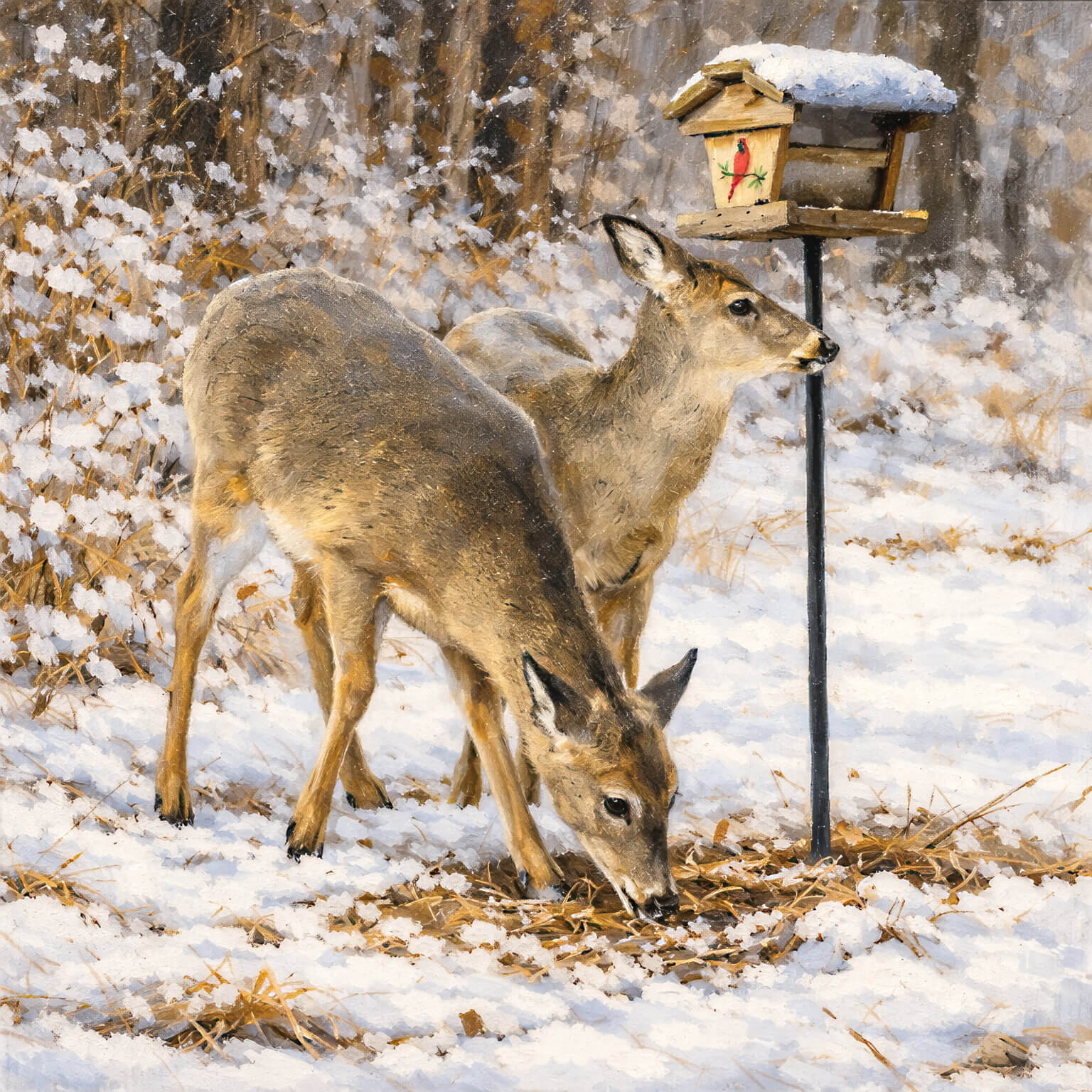
White-tailed deer have adapted particularly well to the current state of things and thrive in the “edge habitats” we have created. Transitional zones where lawns, fields, or open spaces abut woods make excellent feeding opportunities. Deer are not particularly shy animals, and they prosper even in thickly settled suburbs. On its face, this seems very positive.
However, the far more elusive wolves and mountain lions never returned, and the resulting predator/prey imbalance has helped accelerate a deer population rebound. Though coyotes fill some of the ecological void and take some fawns, they seldom kill adult deer.
When deer are on alert and being hunted, they devote less time to eating. This slows population growth, as reproductive success rates drop. Without this hunting pressure, deer move less, eat more, and have higher reproductive success rates.
As a result, most local deer populations are far above the “carrying capacity” of the ecosystem. Optimal density is considered to be 12 to 18 deer per square mile. The area of the state that includes Acton has an estimated concentration of 30 to 80-plus deer per square mile. Some parts of the state have even higher densities, with Martha’s Vineyard and Nantucket at a staggering 50 to 100 deer per square mile.
Though seeing deer is a thrill, there are simply too many of them, ecologically speaking. Deer are selective feeders and prefer the nutritious shoots of familiar trees and plants. This means they avoid non-native invaders like buckthorn and garlic mustard, which allows those plants to flourish. And deer eat a lot.
Estimates of daily consumption are about seven pounds of forage per deer. A pound equates to about 600 newly sprouted seedling “tips,” or about 4,200 per day. No wonder forest managers are raising the alarm about suppressed regeneration of native trees like oaks, hemlocks, and maples. Overbrowsing also reduces habitats for other species and overall forest biodiversity.
Highway hazards
There are other, more obvious effects. Deer-related car accidents have increased 51% in the last decade. In 2024, MassDOT reported a record of almost 4,000 deer strikes, with 146 resulting in injuries, and at least four deaths.
Deer are also a vector for ticks, a factor in the recent surge of tick-borne illness. Over 10,000 cases were reported in the state in 2025, and July saw a year-over-year case increase of 43%. Martha’s Vineyard is seeing a “tick health crisis” emerge, with Lyme and babesiosis cases 11 times the state average. A new “alpha-gal syndrome” (from lone star ticks) causes dangerous and life-altering allergic reactions to red meat. Cases have jumped from two to more than 700 in just five years.
Bowhunting’s benefits
Though sometimes hard to see, the effects of deer overpopulation are increasingly detrimental. Hunting can be useful for reducing deer numbers and starting to relieve the detriments to forests (and ourselves). Rifle hunting for deer is prohibited in Massachusetts; hunters are limited to bow, shotgun, and primitive muzzle loaders. The fall hunting season runs from early October to December 31.
Of these methods, bowhunting (archery) is quiet and considered the safest, with arrows traveling a relatively short distance and most shots taken at a steep downward angle from tree stands. And venison is about as local, organic, free-range, lean, high-protein, and delicious as you can get.
There are many safe, responsible local bowhunters, but the primary limitation is access. Landowners are wary of giving permission if unfamiliar with the particulars. Acton recently conducted a pilot to reduce crop damage at Barrett’s Mill Farm, and towns including Harvard and Sudbury have safe, successful bowhunting programs to help reduce deer numbers and, perhaps more important, alter their feeding patterns and behavior. This can help, but access by landowners must also play a role.
Like most, I love seeing deer and consider them beautiful animals to be respected and appreciated. But I also feel people have a role to play in restoring the predator/prey balance we upended.
Happy New Year, and I hope you will brave the ice and wind and spend as much Time Outdoors with your family as you can. And be sure to look down — you won’t have to walk far to see a deer track.
Wilson Kerr lives in Acton and is an avid outdoorsman and amateur naturalist. This monthly column is written to help grow awareness of the wonders of nature. In this increasingly fast-paced and technology-packed world, it is important to stop and take in the beauty of our area and the animals that inhabit it. The author hopes this column will be read by families and used as a teaching tool and that you will spend more … Time Outdoors.