Time Outdoors: Tiny wings and a prayer
A fledgling robin becomes a lesson in resilience, parenting, and natural selection.
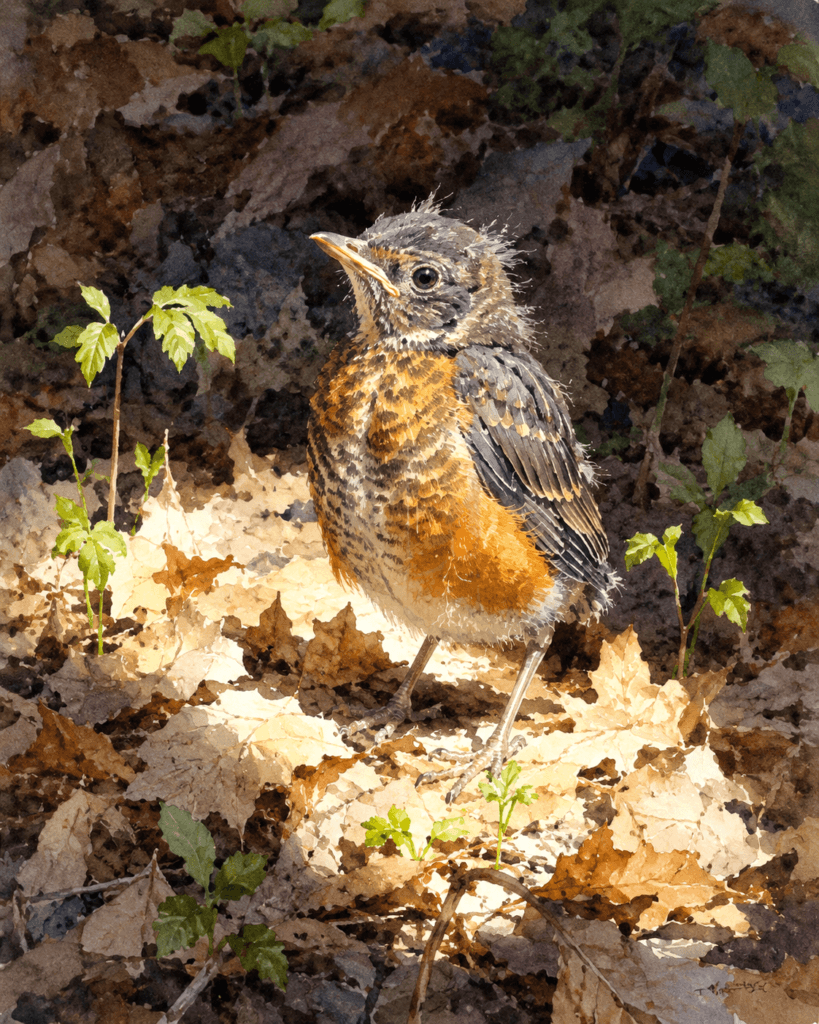
As I pulled into the driveway, I could tell something was wrong. My 9-year-old daughter was gesturing and talking to my wife in a way that signaled distress and dismay. Before I could turn off the car, she ran around to the driver’s side, yelling, “Come quick, I found a baby bird!”

Early June is when young songbirds are hatching. Avian parents are busy flying back and forth to their nests with snootfuls of caterpillars and other bugs — doing their best to feed clutches of tiny, bald, newly emerged hatchlings.
These fragile babies are totally dependent on their parents’ care and, if they fall from a nest, their chances of survival are very low. For most common songbird species in New England, this initial stage of featherless helplessness lasts one to three days.
The next stage of life for a baby bird comes as they develop downy feathers and put on weight dramatically. In just 10-14 days, these “nestlings” will grow to 90% of the weight of their parents, assuming they are well fed and the nest stays in place. Nestlings often have bright “gape marks” outlining their beaks to better indicate to arriving parents where to deposit lunch.
Hopping and wobbling
After a few weeks, assuming diligent parental care, the young birds grow flight feathers and “fledge” by leaving the nest, usually fluttering clumsily to the ground.
These “fledglings” cannot fly, so they hop and wobble around. This stage can last a few days for very developed fledglings to up to two weeks for those that have jumped the gun and left (or fallen out of) the nest a bit early. The parent birds stay nearby, feeding and teaching them how to forage. Finally, after a lot of trial and error, a fledgling takes off on its own.
I got out of the car and followed my daughter into the woods near her friend’s house. The baby bird was in the leaf litter and looked to be a newly fledged robin. It seemed healthy and strong, swaying as it tried to balance upright. The nest was high above in the crook of a maple tree, too high for even my big extension ladder.
I explained to her that the best bet was to leave the bird alone and hope for the best. She asked me what would happen if a fox found it overnight. I explained that death and survival are part of nature and that this is how animal species grow stronger over time. She seemed to understand, as she scanned the trees for signs of a momma robin.
Sadly, this entire process, from egg to a successfully raised fledgling like this little robin, is a best-case scenario. In reality, 40-60% of all songbird nests fail before any eggs even hatch. Predators such as snakes, raccoons, skunks, and blue jays raid nests, and weather events like strong winds or heavy spring rains take a heavy toll.
Once hatchlings emerge from their eggs, 70-80% of them will not live through their first year. While these stats seem stark and finding a dead baby bird or failed nest can be heartbreaking, nature has good reasons for these low success rates.
When a nest fails, parent birds will usually start over, moving to a new, more suitable spot. Over time, this causes bird populations to spread and results in low-probability locations not being chosen again.
Darwin’s ‘natural selection’
High rates of nest failure mean parent birds who chose nesting locations wisely are rewarded by way of having their genes passed along. Charles Darwin called this “natural selection.” And, of course, the high-calorie, abandoned eggs benefit predator species and add nutrients to the food web.
Some species have evolved to prefer locations that put them into conflict with people. For example, house finches get their name from their love for the snug, weather-protected cavities that homes provide. My daughter’s daycare provider told of having to use their back door for a month as house finches successfully raised a family from a nest built in a wreath affixed to their front door.
Most people do not know what to do if they find a baby bird that has fallen from its nest. A common myth is that human scent will cause birds to abandon their young. This is not true, and if you find a hatchling or a downy nestling that seems otherwise healthy and you can locate (and reach) the nest it came from, you should carefully return it. Be sure to wash your hands afterward.
If you find a fledgling on the ground, remember that this is a normal life stage and the parent birds are probably nearby, frightened off by your approach. The best bet is to leave it alone and move away, allowing its caregivers to return.
A hopeful check-in
The next day, my daughter shot off the school bus, tossed me her backpack, and raced for the woods. She came back beaming, telling me the little robin had survived the night and looked fine; she thought she saw the momma robin nearby, with a snootful of bugs.
That was the last time she mentioned the young bird, seemingly satisfied that her presence was no longer needed. Her understanding of and respect for the natural order of things made me smile.
Until next month, I hope you now know a little more about baby birds and that you will spend as much Time Outdoors as possible, enjoying this glorious early-summer weather.
Wilson Kerr lives in Acton and is an avid outdoorsman and amateur naturalist. This monthly column is written to help grow awareness of the wonders of nature. In this increasingly fast-paced and technology-packed world, it is important to stop and take in the beauty of our area and the animals that inhabit it. The author hopes this column will be read by families and used as a teaching tool and that you will spend more … Time Outdoors.